


For Laura Pérez Rosillo, photography is much more than an artistic practice. It is the path she consciously chose, a way of making sense of her life, and a language through which she can express what she sees, feels, and experiences.
Known artistically as Lau Pérez, Laura is a photographer from Mexico City whose work explores Street Photography, Author Photography, and Self-Portraiture. She shares her Street Photography through @lauperez.frames and her Art Photography and Self-Portrait work through @lauperez.art.
Her journey to photography, however, was not a straightforward one.

Lau originally studied Classical Singing at the Faculty of Music of the National Autonomous University of Mexico (UNAM). After graduating as a singer, she experienced what she describes as a kind of vocational crisis. Although she recognized her musical talent, she felt she had never consciously chosen her professional path and lacked the motivation to pursue opportunities as a musician.
Then, in 2015, a casual conversation opened a completely unexpected door.
One day, while having lunch with a singer friend, the two talked about their desire to continue studying or perhaps explore something outside of music. Her friend mentioned someone who had studied Interior Design. Lau, who had always been drawn to creativity and to “forms, colors and textures,” became curious.
“It sounded like something fun,” she recalls.

When she returned home, she began researching Interior Design and looking through the courses students were required to take. One subject immediately caught her attention: Photography.
It was connected to the artistic and creative world that had always attracted her. Suddenly, another question emerged: “¿Existirá una carrera de fotografía?” — “Is there such a thing as a photography degree?
She abandoned her Interior Design research and began searching for photography programs instead. Among the schools she discovered was the Escuela Activa de Fotografía in Mexico City.
“And so, without having any idea what photography was about,” she says, “but with the feeling that I had found something that had to do with the creative part that attracted me—colors, shapes, textures—my photographic path began.”

A camera as an extension of the mind
Lau had always felt drawn to the Visual Arts. Before photography entered her life, she imagined herself working with painting or graphic design. Photography simply “did not cross my mind” until 2015.
What ultimately captivated her was the possibility of creative expression.
“Feeling that I can cover and satisfy this need to capture emotions, sensations and ideas through images,” she explains, is what drew her deeper into photography. “Little by little, I have become more and more engaged and in love with it.”
When she decided to take a diploma course in Digital Photography, she purchased her first camera because she needed one to begin studying and, as she puts it, “to know what this thing of making photos was about.”

Today, however, she sees the camera very differently.
“For me the camera is an extension of my mind and my gaze,” she says. “It offers me the resources I need to share my vision of the world, to express myself, to create.”
She compares making photographs to painting.
“When I make photographs I feel as if I were painting with a brush on a canvas. I like to think of it that way.”
That creative impulse is not entirely surprising given her family background. Lau grew up surrounded by the arts. Her parents were musicians—her father studied Choral Conducting and her mother studied Piano. Her sister studied dance, her maternal grandmother painted on porcelain, and an uncle on her father’s side is a ceramic artist.

Learning to see
Lau began her photographic education through diploma programs in Digital Photography at the Escuela Activa de Fotografía. She later took a photography course at Objetivo Valencia in Valencia, Spain, in 2019.
But while formal education gave her the technical foundations, much of what has shaped her as a photographer has happened through experimentation and practice.
After learning the basics of capturing images, she began searching for online courses and watching YouTube tutorials. Yet she considers much of her development self-taught.
Through practice and exploration of different photographic genres—Street Photography, Self-Portrait, and Art Photography—she gradually began to consolidate what she calls, “her gaze.”
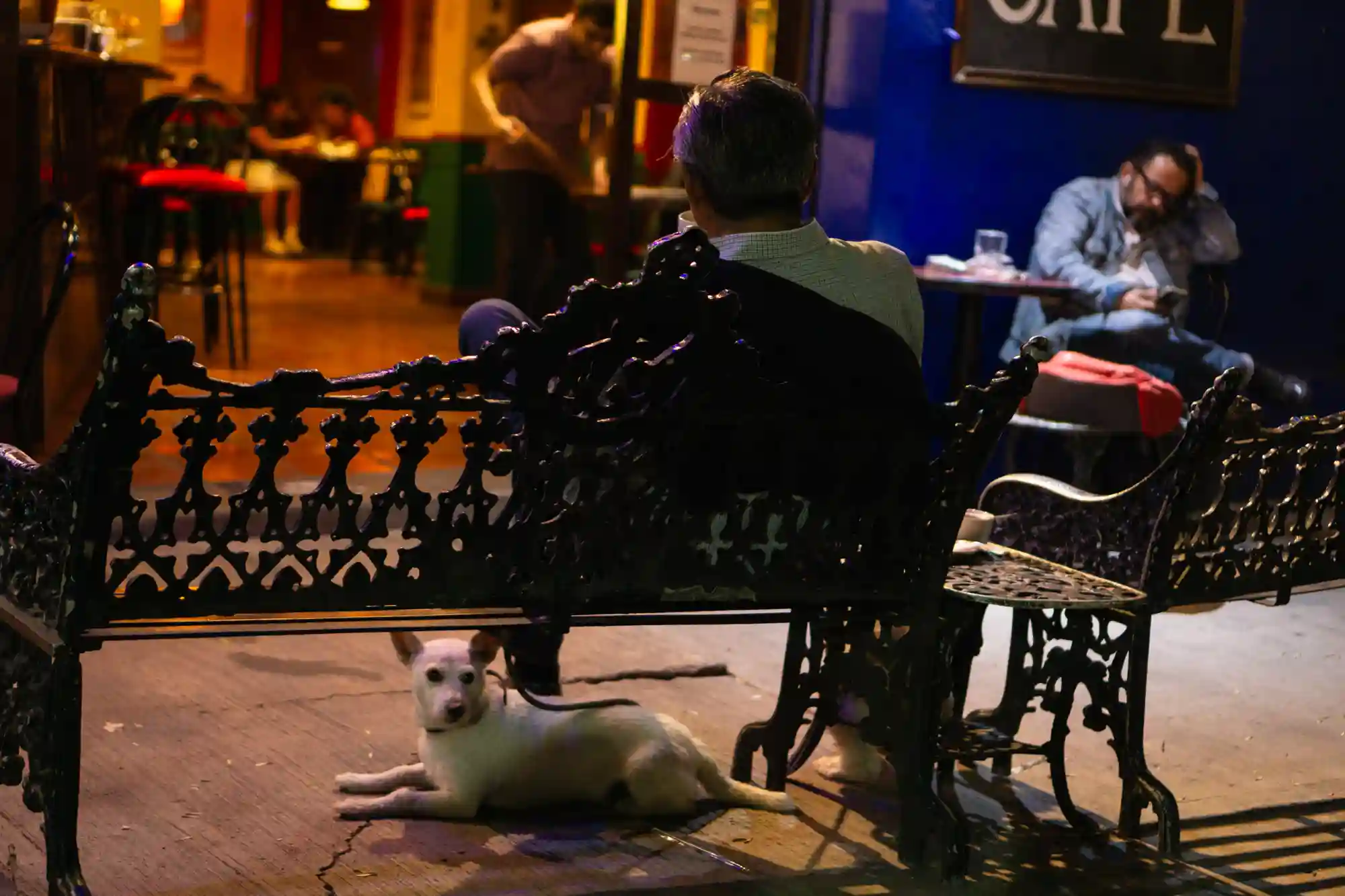
“Each one has challenged me and made me resolve the different situations that arise when making photographs in a dynamic and creative way,” she says.
That process of learning has also helped her understand what photography means to her.
“Photography is my path, the one I consciously chose. My way of giving meaning to my life. My sense of belonging. My freedom. The language I most enjoy learning and the one I most enjoy speaking.”
Life as the subject
Although Lau works across three genres—Street Photography, Author Photography, and Self-Portrait—she sees a common thread connecting them all.
“In all three my subject is LIFE, captured from my artistic interpretation,” she explains.
Sometimes life itself is her subject; at other times, it becomes her source of inspiration through her own experiences and internal processes. Visual stimuli such as light, colors, and shapes can trigger something emotional within her.
She describes these sensations in almost tactile terms—as if visual inspiration could become “caresses, aromas, feelings, sounds and silences.”

Her role, then, is to translate those experiences into an image.
Lau believes that every photograph inevitably reveals something about the person behind the camera.
Whether she is making Street Photography, Author Photography, Self-Portraits, or another kind of photograph, “the way I make photos and what I show in my images speaks about my way of seeing, thinking and relating to the world. Of my history and of who I am at this moment in my life.”
Then she makes the connection explicit:
“Making photography is, in some way, making a self-portrait.”
Her approach to style reflects that same desire for freedom. She does not want to restrict herself to particular colors, a specific aesthetic, or a predetermined finish.
“I like to approach each image independently,” she says, “because I consider that each one has its own personality.”
The exception is when she is working on a series, where a connecting thread requires consistency.
Still, certain elements have begun to distinguish her work: her approach to light, her use of shadows, and her expressive use of blur and motion blur.

Finding beauty in everyday life
For Lau, Street Photography is particularly compelling because it allows her to encounter life as it unfolds.
She is drawn to “human expressions,” spontaneous gestures, and the ways people interact with one another. She is fascinated by compositions in which light seems to enter into a conversation with her subjects—whether those subjects are people, animals, plants, or objects.
“Reflections, shapes, colors, textures” move her.
She connects with the scenes she photographs emotionally, through her sensitivity, and hopes to offer that same feeling to the viewer “in a poetic way.”
At the heart of her work is a desire to celebrate everyday existence.
“I seek to capture the kind side of life,” she says. “To show the beauty and magic of everyday life.”
She wants her photographs to inspire human connection and to “touch and stir sensitive places” within the viewer.
For Lau, art can become a way of slowing down in a world saturated with images.
“I am interested in making my art a tool for evoking emotions and encouraging deep attention, stopping time.”

Mexico through her eyes
Lau’s relationship with Mexico is also present in the way she sees the world.
“Mexico is a joyful country because of its colors, its traditions, and its celebrations. Even its incredibly diverse cuisine somehow speaks to the same thing. I would say that, in general, we are warm, empathetic, and kind…I am speaking specifically about Mexico City, the place where I grew up. It is a dynamic city where people are always looking for ways to move forward, and they succeed thanks to their creativity. People here are persistent. They come up with ways to sustain themselves. Good businesses and bad businesses, but they never cease to be ingenious.”
Reflecting on Mexico City’s influence on her art, she says,
“I’m not entirely sure how my community has influenced the way I approach photography—I mean in terms of style—but what I do know is that persistence and creativity are my two most powerful weapons. They are what keep me on my photographic path.”

The challenge of making a living through art
Like many photographers, Lau recognizes the difficulty of building a sustainable career in an environment saturated with images.
“The main challenges in Mexico and the world are that the saturation of images on social media and the lack of value that is generally given to art make it difficult to make a living from it.”
She also sees the enormous number of talented photographers as both inspiring and challenging.
“There are so many talented photographers and this is wonderful, but obviously it becomes very difficult to stand out and access opportunities.”
Rather than waiting for those opportunities to appear, Lau is increasingly interested in creating them herself.
She is building her own entrepreneurial path, creating community and connecting with an audience that identifies with her photographic proposal. Her plans include Photography Classes, Photo Walks, and eventually selling her Art Photography.
She intends to continue participating in calls for submissions and competitions as well.
For Lau, some of the most rewarding aspects of being a photographer in Mexico have little to do with recognition.
They include connecting with people who share her passion, contributing her perspective to the community, raising awareness through her work, and “sharing a little piece of Mexico with the world.”

Into the streets
Before heading out for Street Photography, Lau prepares carefully—but subtly.
She likes to be comfortable and usually dresses in black or dark colors so that she can go unnoticed. At the same time, she likes to look “a little put-together,” so that when people notice her, they perceive her as harmless and do not feel suspicious.
Her equipment is intentionally simple: one camera, one fixed-focal-length lens, three fully charged batteries, and three empty memory cards.
She also prepares some of her camera settings beforehand so that she does not have to spend too much time adjusting the camera once she is out on the street.
The goal is to be ready to respond when a moment presents itself.

“Fotos Rotas”: An opening into Street Photography
One project holds a particularly important place in Lau’s development: “Fotos Rotas” (“Broken Photos”), a personal project she created in 2025.
The project consisted of 12 groups of photographs—one for each month of the year—with a different theme each month. For Lau, it was essentially an excuse to give herself permission to experiment artistically.
“It was a personal project whose objective was to give myself the space to experiment in photography,” she explains.
It was also the project that gave Street Photography a much more important place in her artistic journey.

During “Fotos Rotas,” Lau created a series called Memorias sobre un Puerto (Memories of a Port), photographing scenes during a family vacation in Puerto Telchac, Yucatán.
The place had a particular appeal to her family because of its beach and its peacefulness. Since it is not heavily tourist-oriented, she describes it as tranquil. She has also experienced what she considers some of the best sunsets of her life there.
One afternoon, her family went out to walk and watch the sunset. Lau brought her camera because she wanted to make photographs for that month’s “Fotos Rotas” theme, which focused on Street Photography.
She did not know then how significant those photographs would become.
The scenes were “so full of life, of naturalness,” she remembers, illuminated by sunlight that “felt and looked as if it were a caress.”

And because she loves playing with shadows, she was able to make use of something she naturally finds compelling.
One of the photographs from “Memorias sobre un Puerto” was later selected for the Mexican Women Photographers project developed by Sunny Quintero for the exhibition, Fotógrafas de la Vida Cotidiana IV Edición, alongside 99 other talented Mexican and Latin American women photographers.
For Lau, that photograph did more than open a professional door. It changed the direction of her artistic journey.
“It is an image that has not only allowed me to begin opening doors,” she says, “but that makes me go back in time and remember how I experienced that moment.”
She remembers having a powerful feeling while photographing the scene.
“I felt that I was really standing before something important. I had a kind of premonition.”
The experience ultimately led her to make a decision: She wanted to deepen her path in Street Photography.
“‘Fotos Rotas’ led me to explore Street Photography,” she says, “a path that, although I have only been on it for a short time, I feel has already given me so much personally and in my development as a photographer.”

Looking toward what comes next
Lau’s journey in Street Photography is still relatively young, and for now, “Memorias sobre un Puerto” remains her primary series in the genre.
But she already has ideas for what comes next.
She would like to create a photographic series inspired by Mexican music—a kind of experiment in which she explores what happens when a musical idea, perhaps a popular song, becomes the starting point for seeing and photographing the street.
She is also collaborating on Fotografar Palavras, a project by writer Paulo Kellerman that she particularly enjoys. The project transforms words and texts into photographs.
Meanwhile, Lau continues to develop her own Photography Classes and Photo Walks and plans to begin selling her Art Photography.
In 2026, her primary focus has been developing herself through Street Photography while continuing to create Art Photography.

Trusting the path
Perhaps the most revealing part of Lau’s story is the advice she would give to her younger self.
She would tell herself that discovering the direction one wants to take in life requires taking the risk of moving forward and seeing what happens.
“To know the direction you want to take in life, there is no choice but to venture out and take steps to see if that is the path.”
She would also remind herself that feeling fulfilled and in alignment is a way of recognizing when you are where you are supposed to be.
And she would offer one final piece of advice—one that seems particularly connected to her own unexpected journey from music to photography:
“Not all important decisions have to be made from the mind. Some have to be felt in the body, in the stomach, so as not to disappoint our deepest desires.”
That same philosophy informs what she tells younger photographers.

She encourages them to learn the technical side of photography well—not simply to operate their equipment, but ultimately to move beyond the technical mechanics and communicate what they truly want to say.
“The camera is an extension of the mind and the gaze,” she explains. Learning the technical foundations allows photographers first to get the most from their equipment and then “to integrate it and transcend it,” so they can capture and communicate what they want as precisely as possible.
She summarizes this idea with a phrase of her own:
“Speaking photography: Being capable of translating into images what we imagine, see and feel, making the most of the resources our working tool offers us.”
And then comes perhaps her most important advice.
The moment to begin does not necessarily arrive when we feel completely ready.
It arrives when we decide to begin.
“The moment to be ready to undertake something will arrive when the decision is made to begin and one acts accordingly.”

Fear, she believes, often convinces us that we are not ready yet.
“And it is very sad,” she reflects, “but I think this fear makes us lose so much time and so many opportunities.”
For someone whose photographic career began with a question—Is there such a thing as a photography degree?—Lau’s journey is a reminder that sometimes the path reveals itself only after we take the first step.
And her dream for the future is beautifully simple: to exhibit her work in Mexico and in other countries.
For now, she continues to walk, observe, create, and translate the world around her into images.
One photograph at a time.
To Learn More Visit:
 Soledad Quartucci, PhD, CEO, Latina Republic
Latina Republic’s cultural reporting highlights the artists, storytellers, and visionaries shaping the creative heartbeat of Latin America and its diaspora. Through in-depth interviews and narrative features, we celebrate the traditions, identities, and everyday histories that define our communities. Our work uplifts emerging and established voices, giving space to the cultural movements, personal journeys, and artistic expressions that inspire connection and deepen understanding across the Americas.