


Argentina’s National Identity Document: “X” for Nonbinary
On July 21, 2021 the president of Argentina, Alberto Fernández, made an announcement regarding a new national identification document for people who identify as nonbinary. The government stressed that Argentina is the first country in Latin America to enable this right, as others in the world such as Canada, Australia and New Zealand have already done.
The incorporation of the symbol “X” in the national i.d. card is now an option for a person who identifies as neither female or male. This marks Argentina as the first Latin American country to legally allow people to identify as nonbinary under the section identifying “Sex” in the national identification card (DNI).

“Step by step we are making possible what seemed impossible, and every day we are closer to the ideal, which will be reached when all of us are included and no one cares about the sex of the people,” said Argentine President Alberto Fernández, in a ceremony in Buenos Aires in which the first three documents with the new regulations were handed over to three people.
“It is a step that we are taking that I hope will end the day in which nobody is asked in the DNI if they are a man, a woman or whatever. Because that is what we really have to achieve. What does the State care? Why should the State know the sexual orientation of its citizens? ” he asserted.

Some political representatives and social organizations, present during the ceremony, demonstrated their disapproval with the use of an “X” to label nonbinary identity, yelling, “We are not an X!”
The Minister of Interior, Eduardo “Wado de Pedro, commented on the positive impact of having a more inclusive, diverse and just society. In the same way, the Minister of Women, Gender and Diversity, Elizabeth Gomez Alcorta, showed her support and claimed that “amplifying and recognizing rights” is part of the current political goal.
EN VIVO | El presidente Alberto Fernández anuncia la puesta en marcha del DNI para personas no binarias https://t.co/b0orN4fxAw
— Casa Rosada (@CasaRosada) July 21, 2021
DNI for Nonbinary People
Objective: The nonbinary DNI functions will recognize the right of gender identity to those who identify with neither male of female. This measure respects the individual and allows them to obtain their passport and identification under nonbinary.
What does the “X”mean: The nomenclature “X” represents the vision of individuals that do not label themselves as male or female and that label themselves as nonbinary, undetermined, not specified, etc.
How to obtain it: People of argentine nationality must go to the national registry headquarters or to the Civil Registry office. Foreign people residing in Argentina are able to do so at the National Migration Department.
In 2012, Argentina passed a Gender Identity Law that stated that people have the right to their gender identity and individuals may solicit a sex registration rectification. This allows for people to change the gender and name on their identity card and birth certificate. There’s also the International Covenant on Civil and Political Rights which protects the rights to recognition before the law, privacy, and nondiscrimination.
Gerónimo Carolina González Devesa, a 35 years old doctor became one of the first Argentines to receive his non-binary National Identity Document (DNI). The ceremony was held last Wednesday at the Bicentennial Museum and was attended by President Alberto Fernández.
Mañana @alferdez junto a @wadodecorrido y @EliGAlcorta le entregan el Dni no binario a @gc_gonde y no podemos más de felicidad. Ampliando derechos. Libertad, identidad, dignidad. Argentina maravillosa pic.twitter.com/oSORVh3yPk
— eleonora lamm (@elelamm) July 21, 2021
“I feel that, for the first time in my 35 years, I will be free. I will stop giving explanations to society about my identity. This step that the country will take is historic and being one of the previous marks fills me with pride. I will stop shaking every time they ask for my ID,” he told Argentinian press, El Sol.
Regarding the vicissitudes that he went through, the young man said that there were many stones, but the worst thing was not being able to carry out procedures because his face (now with a beard) did not coincide with the photo of the DNI.
“All the time they believed that I was falsifying my identity because a woman appears on the DNI and I am dressed as a man. It happened to me at the airport, in a bank, in a supermarket and it was not pleasant at all,” he said.
Now, with his new non-binary DNI, Gerónimo will be able to circulate without giving explanations thanks to Decree 476/2021, which establishes that “the nomenclatures to be used in National Identity Documents and Ordinary Passports for Argentines in the field referring to ‘sex’ may be ‘F’ -Female-, ‘M’ – Male- or ‘X.'”
The International Civil Aviation Organization (ICAO) was notified about the modification made to these documents. At the same time, the International Registry of the People will inform individuals who are soliciting a new or updated National Identity Document (DNI) or their passport about the possibilities of not having their sex recognized as “X” in certain states.
The National Registry of Persons (RENAPER) must now inform all those who request the issuance of the DNI and / or the Passport with the nomenclature X “about the possibilities of having their entry, permanence and / or transit situation restricted in those States in which no other categories of sex other than binary ones are recognized, regardless of whether your Travel Document is a National Identity Document or a Passport,” explained La Nacion, Argentina.
La Nacion consulted the United States Embassy in Argentina, which clarified that until now, only the male and female gender options are available for a US visa applicant. “Applicants must choose one or the other when preparing their application. online visa. The gender reflected in the sex field in any visa issued must match the gender reflected in the sex field in the applicant’s foreign passport,” they indicated.
“If a foreign passport does not include a gender / sex field male or female, the applicant must select male or female for the US visa application and in such cases the Department usually issues the visa based on the indication of masculine or feminine gender chosen by the applicant,” the embassy added.
Dyhzy, President Alberto Fernández’s son was supportive and welcoming of the change: “I’m going to change my ID, I’m a non-binary person.” In a live broadcast on Instagram, Dyhzy celebrated the initiative: “When the State recognizes a law, that law becomes naturalized. Today it is not unusual, it does not attract attention, to see a homosexual couple getting married, since same sex marriage has been approved. This type of rights must first be recognized by the State to produce societal change. Now people have to deconstruct themselves, as there are still people who are transphobic, homophobic, Dyhzy told El Perfil.
View this post on Instagram
“Today is a historic day, a day of great happiness. Today is a day where Argentina begins to put an end to binary logic, where we expand rights (…) We are taking one more step towards a more inclusive, more diverse and fairer society,” said Interior Minister, Eduardo” Wado “de Pedro. The official expressed that when a government generates an “expansion of rights” it is because before there was a collective struggle, and he thanked the social groups that fought for it.
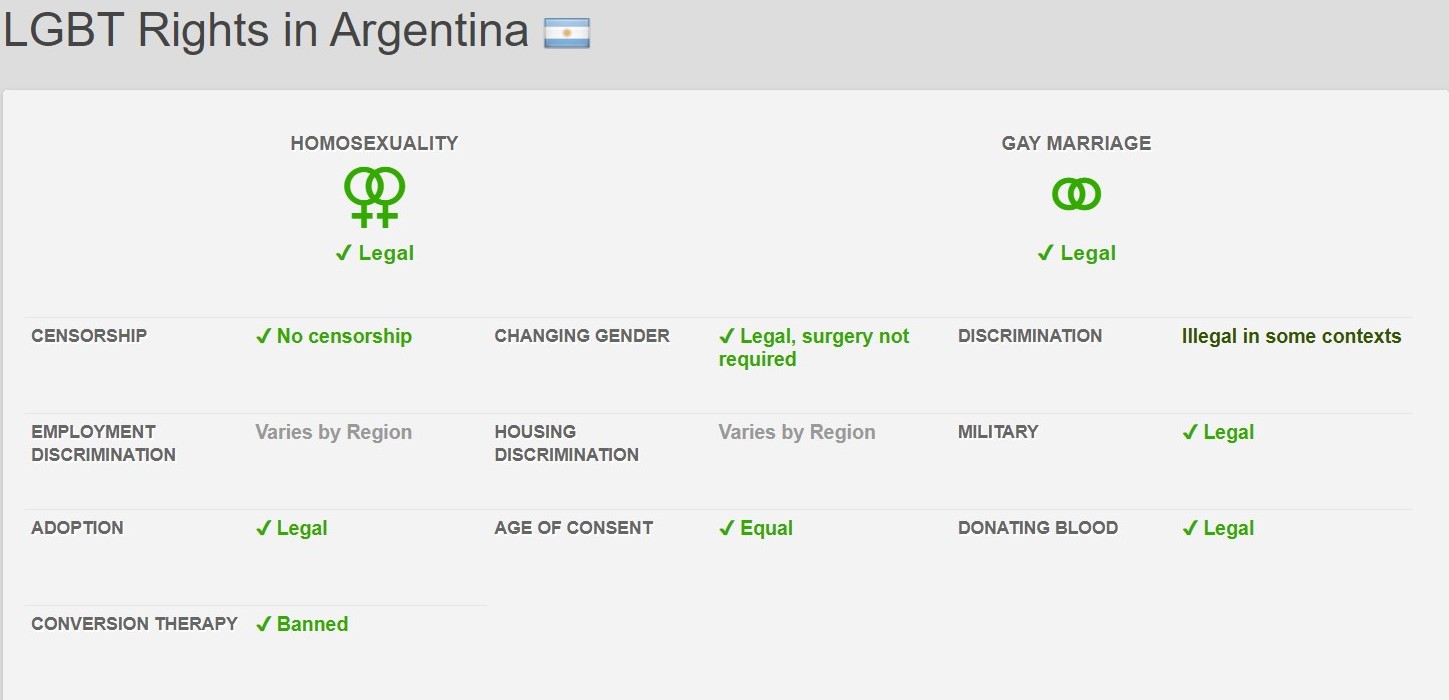
For more information regarding LGBTQ rights in Argentina by Province visit: https://www.equaldex.com/region/argentina
_______________________________________________________________________
 Nancy Ortega | University of California, Davis
My name is Nancy Ortega and I am a current undergraduate student at UC Davis majoring in Animal Science and Spanish, but began my studies at Rio Hondo College. I am the proud daughter of two immigrants and the sister of a Dreamer. My interest in Latin America emerged due to the passion from my high school Spanish teacher. I became interested in the variety of cultures, the unique people, and the history still to be uncovered from underrepresented countries. In Latina Republic, I want to expand the beauty and complexity of Latin America and enrich my mind, as well as that of the readers, throughout this new experience. I look forward to meeting interesting individuals, hearing new stories, and coming out with a fresh mind set.