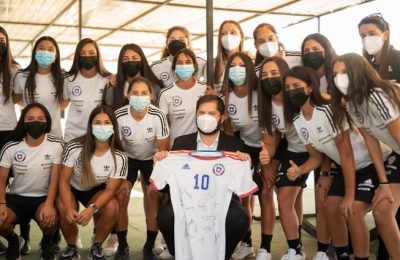
It’s been a year since Pablo Pilquil Sepulveda founded the LGBTQ+ Migrant and Refugee Network in Chile in June 2020, the first of its kind in the country. Since its inception, the network has assisted at least 100 forcibly displaced LGBTQ migrants and refugees in the past year – in securing employment, housing, and immigration papers.
According to the UNHCR, the majority of migrants and refugees in Chile are from Venezuela, forcibly displaced from their home country due to the ongoing humanitarian crisis. LGBTQ Venezuelans are widely discriminated against in a country where the government does not recognize same-sex relationships or the changing of assigned gender.
A social worker by training, Sepulveda has spent the past 8 years assisting refugees and asylum seekers in Chile at the Social Help Foundation of Christian Churches (FASIC). But over time he realized that he and his colleagues were treating all refugees’ cases the same; there wasn’t any specific attention given to, for example, the trans community, Black and Indigenous refugees, or the LGBTQ community.
Sepulveda himself is openly gay. “For a while I didn’t think that was particularly important,” he says, “but [the formation of the network] has allowed me to take out the last foot I had left in the closet.”
Right now the network is gearing up to release a guide for LGBTQ migrants and refugees in Chile, that breaks down the asylum process and anti-discrimination laws.
Latina Republic spoke with Sepulveda about the work the LGBTQ+ Migrant and Refugee Network of Chile does, and about the current issues the two intersecting communities are facing.
What are the biggest challenges for LGBTQ migrants in Chile?
Mainly access to regularization [of immigration papers], access to health care, access to live freely and with full rights – to live their sexual diversity, their gender identity and sexual orientation. And [also] self-representation because finally they themselves must be their own voice, they themselves have to tell their stories of their lives, because most of the organizations that serve migrants and refugees here in Chile are linked to churches. That’s why this network was born – to give continuity and specialized attention to diverse people, not to be their voice, but to advocate for their rights.
What was it like founding the network? It seems like you created an intersection of LGBTQ and migrant organizations that didn’t exist before.
We began to visit various LGBT organizations to learn about their work and we realized that almost none of them had anything budgeted, planned or executed in relation to migrants and refugees. So we began to talk to them to find out if they would be interested in being trained about the reality of migrants and refugees. We contacted organizations that are well known here in Chile such as MUMs, Agrupación Lésbica, Rompiendo el Silencio, or Acción Gay, Chile Positivo, among others.
Have you noticed that LGBTQ+ people are often excluded from migrant organizations?
The networks of attention for migrants are always linked to the churches. So the issue is that LGBT people have expectations about how they will be discriminated against. We call it the process of shutting themselves back in the closet, because in the end they do not see institutions or spaces to open up to, to be able to ask for help.
It’s been a year since the launch of the network in 2020 – what have been some of the achievements, and what are you looking forward to next year?
The network was launched in conjunction with a visibility campaign that we did, from which we collected testimonies of refugees and migrants that ended up in a book that was developed by a Venezuelan organization called Americonera. It was like a first step of visibility because here in Chile we did not talk about LGBT migrations before.
We always talked about heteronormative migrations, based on heterosexual families and we always talked with the masculine article [el] to refer to migrants and refugees. The goal this year is to decentralize the network, that is, to involve organizations from other cities as well – not just organizations from Santiago.
We have learned a lot; I think we need to have more capacity to gather information. At the moment the network does not have resources. We are working only from self-management and looking for possibilities to apply for projects together with the network in order to give it more visibility and do more things.
Next year we are also planning to create a training school for migrants, people in the LGBTQ community, and also for the national population, about migratory law, about the right of diversity in Chile, access to healthcare – we’re hoping it will be a big campaign.
How does the LGBTQ+ Migrant and Refugee Network work? How do you coordinate between the different organizations?
I’m the coordinator of the network, as part of the manifest collective (“Colectiva Manifiesta”). We have monthly meetings and right now since we’re launching our manual soon we’ve been meeting weekly. We have an exclusive WhatsApp number for the network, because I have many years of experience in dealing with cases of refugees and migrants, so we are opening a space in case we have people who need attention or advice and cannot find it, so that they can approach the network.
Can you tell me a little bit about Colectiva Manifiesta?
We are all volunteers within that collective, we also give attention to migrants and refugees, who are looking for accompaniment, attention, etcetera. This collective is currently in a crowdfunding process to find out if we can now get a psychologist.
So the work that you do is very transgressive for Chile, isn’t it?
Yes it is transgressive, based on self-management for the moment. We were pioneers in Chile talking about LGBTQ migration. Today there are larger organizations that are also taking up these issues, but we were the Pioneers.
Are there shelters in Chile specifically for LGBTQ migrants?
There is no shelter for LGBTQ+ people, and there is no specific shelter for migrants either.. Shelters here are general for all people. The year 2020-2019 I think, the UNHCR financed a house for migrants, but it was only for women and children, so of course the objective was achieved, but there is a problem with the issue of separation of families because for example families arrived with their complete nucleus, both men or women, and the men had to be separated from the women and children. Almost all of the other shelters are linked to the Catholic Church, but they are only for individuals, and also the people housed there often have alcoholism problems, addiction problems, for example, mental illnesses.
Are there any located along the border?
On the Peruvian side of the border, but not within Chile.
I understand that there is a new migration law that was passed recently in Chile – what do you think of the bill and what are some migration policies that the Network advocates for?
The new law is still being fully implemented, many civil society organizations talk about the fact that this law goes backwards in terms of people’s rights, it is based on the concept of “putting the house in order,” that is, it is a much more restrictive law, because in addition, under the law most visas are obtained outside the national territory. So often people coming from Venezuela, for example, have their registration and certification system down, or it works badly or they are very expensive.
People coming from another country do not always have the money to obtain the documents needed for a visa. We are in a process of migratory regularization for people who have been inside the country since before March 2020, OR who have had irregular entry before 2020, but Venezuelans have many problems with the issue of expired passports, birth certificates, often times people do not have criminal record certificates – they are very difficult for people to obtain with the Venezuelan embassy for example, or also with the Colombian embassy, because we are talking about countries that are in crisis and with high levels of poverty.
Have deportations of unauthorized persons also increased?
When mass deportations are carried out, it is always said that these are people who have committed crimes and in our work we have also found that not all the families are people who have committed crimes, but there are many who are also deported for entering in an authorized manner. So nowadays there is a lot of fear, some people tend to stay at home so as not to be controlled by the police.
Is there a specific way to request asylum as part of the LGBTQ+ community?
Our country, like many countries in the region, has not established protection for LGBTQ people specifically in our 2010 law for the protection of refugees. However, within the definition of our law there is mention of the persecution of certain social groups.
There was a case a couple of years ago when a gay couple from Senegal where the condition of being refugees was recognized and they were given protection. The persecution in that case was due to their religion. In Senegal, there is no prohibition of being LGBT in the constitution, but nevertheless there is implicit persecution by religious groups and state groups against the LGBT community.
Within the network, has the idea of advocating for humanitarian policies been discussed?
We have conversations within the network about political advocacy so that hopefully the government or this Constituent process within the country will listen and make visible the rights of LGBT diverse people and refugees – not only about regularization or the acceptance of a refugee application – but also about access, for example, to the gender identity law.
Today the gender identity law in our country is a very basic law and there are trans diversity organizations working to influence the change of this law, but for example, for trans migrants, although it allows them access, they are conditioned to have a birth certificate. So there is a whole issue that we are working on and reflecting on within the network, so that we can also influence these changes or this constitutional process to include the rights of migrants and refugees.
Are you thinking about LGBTQ migration policies within the constitution?
Yes, that is, not only LGBTQ, but also within the general population. There are no immigrants or migrants in the Constitutional Assembly. And of course we talk about plurinationality and many other issues, but no one in the Constituent Assembly so far, or at least very few, have talked about the integration of refugees and migrants. It’s important that all rights are universal within the Constitution.
How do you see the current push for marriage equality?
I think that it’s an advancement for society, for us to recognize that times are changing and everyone deserves equal rights. Some organizations see it as a huge achievement, while others remain critical of the fact that there are other much more fundamental rights that we should have before marriage. Right now we have a civil union law that LGBTQ+ people and migrants use; for example I had the case of two husbands from Cuba and Venezuela that got a civil union.
Keep an eye out for the network’s upcoming manual, which they hope will shine more light onto the inequities faced by LGBT migrants in Chile and the Southern Cone.
Contribute to their work by donating to Manifiesta Sin Fronteras.
________________________________________________________________________
 Dashiell Allen | Reed College Alumni
Dashiell is a graduate of Reed College where he studied Latin American and Peninsular Spanish literature. At Latina Republic, Dashiell elevates the voices of activists and organizers that work to promote human rights and immigrant rights throughout Latin America. His work contributes to the organization’s mission of breaking stereotypes and bringing attention to underreported stories throughout Latin America.