


Emberá Querá, an Indigenous Community that Safeguards its Customs and Traditions
Emberá Querá, Province of Colón
Panamá
The history of Emberá Querá began with the Spat Flaco family, a group that founded the community 15 years ago and who originate from the province of Darién.
“Since we were already coming from Emberá communities working on tourism, we later decided to settle in the province of Colón, on the shores of Lake Gatún,” says Militza Flaco, daughter of the chief of the Emberá Querá community.
The community is made up of 60 people who are members of 20 families between children and adults. The land has nine hectares. A part is destined for the use of the residents and the rest is kept in natural conservation.
Each one has a role in the community headed by the leader. The villagers divide the daily work, for example, the kitchen, the plantations, the dance and the botany.

The community’s economic support is sustainable tourism. In 2019 they received 10,000 tourists, of which 90% of the visitors were foreigners and 10% were Panamanians. Although tourist numbers have decreased due to the pandemic, in 2021 and 2022 tourism has gradually increased. The community is in its recovery phase.
“The pandemic was a test for everyone and this taught us that we should not depend on tourism alone. At this time, the inhabitants of the community went outside our territory to sell their produce, their bananas. Others sold fish and the girls created an online page to sell their handicrafts,” she says.
On the subject of training, the Ministry of Education hired a teacher who only teaches at the primary school level in Emberá Querá. For the pre-middle and middle education stages, it is much more complex since to attend schools they must take a canoe trip (boat), which takes 15 minutes, and they must pay additional expenses, such as gasoline. For their training in higher studies, they must move in the same way.

Regarding health, Militza points out that before the pandemic, the Ministry of Health used to conduct medical tours and visited the community at least once a year; however, after Covid-19 this situation worsened.
“Many members of the community currently prefer not to go out due to the situation of coronavirus. We have traditional doctors, but they do not cure all diseases, which is why in more serious cases that require surgery, they recommend going to the hospital,” she explains.

Gastronomy and Culture
The community’s most popular dish is the bodochi, a rice-based bun that has no additional ingredients. The way to prepare it is to wrap bijao leaf and let the food boil for approximately two to three hours. Another favorite dish in the community is guacuco soup.
Regarding cultural traditions, the daughter of the community’s leader admits that preserving their customs in the midst of today’s world is difficult, but despite this situation the community maintains a balance between their traditions and those practiced outside their territory.

“We try to make each child feel proud of who they are when they go outside, either to educate themselves or for another reason. We prepare them to face challenges,” she says.
A benefit within the community is Internet access, which makes it easier for them to showcase the best of their traditions through social networks.

In relation to the language, each member of the family tries to teach their language of origin to the children, but the first language they learn is Spanish, so that the children don’t experience confusion when they attend school.

“The teacher who is in the community is not of indigenous origin and the best thing is for the children to learn Spanish well to avoid learning difficulties. We are also advocating for the Ministry of Education to hire an Emberá teacher so that the children do not have to learn another language first, but ours,” she indicates.

Dress
Women’s clothing consists of a blouse made with coins that are collected and some are passed from generation to generation, that is, old coins.
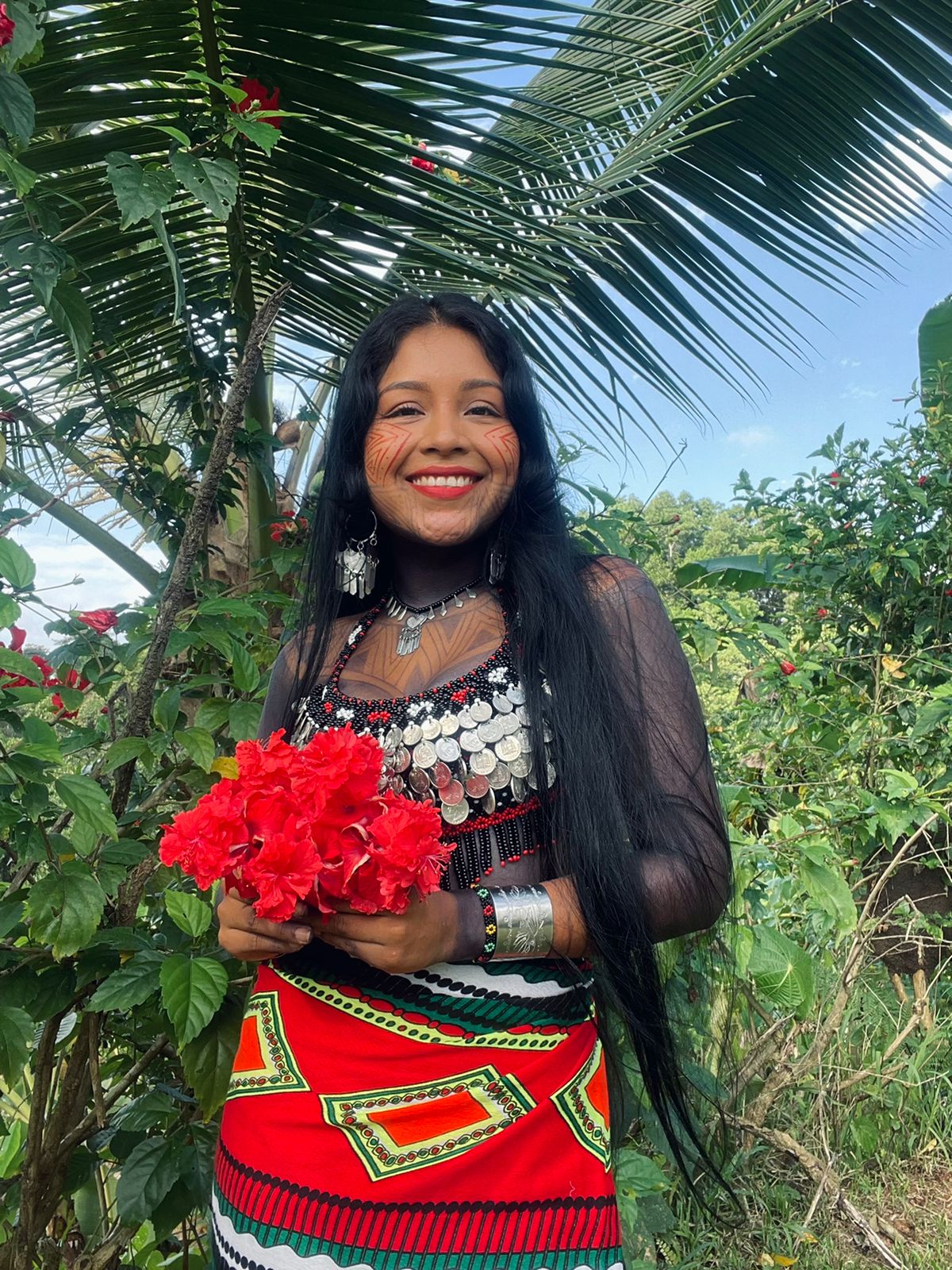
This outfit is not used every day since they only wear this clothing on special occasions.
“At home we use a cotton blouse or other material, but the grandmothers of the community do not wear clothes to cover their torsos since that was the original way to dress. They only covered the lower part of their body,” she narrates.
A complement to women’s clothing is a skirt with patterns drawn on the fabrics called, parumas. The patterns are made in Panama, but the fabric is made in China or Japan, and according to Militza, once its preparation is finished, the material is imported again to Panama and Colombia, since they are the only two countries in the region with the presence of Emberá people.
Regarding the male attire, it is called amburá and it is basically a cloth that covers the lower part of his body, the color is free and it is complemented with beads that are bought in Panama City. The women of the community are dedicated to making the men’s clothing.
In addition, they use a body paint that is extracted from a fruit known as kipara. To obtain the paint, they first grate the fruit as if it were a coconut, extract the juice from the fruit, then let it dry in the sun for approximately 3 hours, then decorate their body with this paint and draw patterns typical of their culture. These designs can last on average a week. Also, women use this product for hair care.
“I invite you all to visit our community and live the unique experience of being with the indigenous peoples, learning about our customs and traditions,” she exhorts.
Astrid Chang | Correspondent for Panamá
Astrid Chang has a degree in Journalism with an Emphasis in Audiovisual Production. Since 2018, she has been a journalist at La Estrella de Panamá. Her work in the newspaper was initially as an intern, where she developed in the area of sports, nationals, social networks and the web. Later, she was hired to lead the themes for World Youth Day and to be a presenter for the segment “Flash Economy.” She later became part of the Café Estrella team, a new content proposal by ‘La Decana’. In this booklet she has written articles on the environment, technology, health, sports, society, music, culture, sexuality, art, fashion and tourism. Likewise, she has organized and directed projects with visual artists for the International Book Fair of Panama. She too, was sent special to cover the Lima 2019 Juegos Parapanamericanos, and currently she is the coordinator of sports issues in the newspaper. She has training in journalistic leadership.

