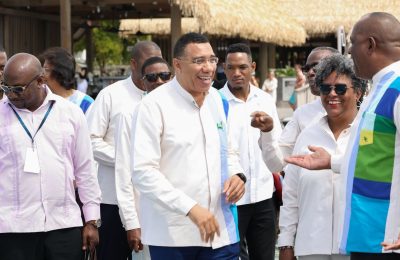
Recent efforts by Jamaican citizens and the police force have tackled the issues of criminal activity throughout the country.
Decrease in Homicide and Violent Crime Rates for Jamaica
The prevalence of crime over the past year in Jamaica has been relatively turbulent and concerning for citizens alike. There has been a growing need for change both on the governmental and local level, and the efforts to combat this issue are finally seeing areas of success. From the first quarter of 2023 until now, there has been a decrease in violent crime rates, down 22% compared to rates in 2022.
To further categorize this statistic, homicide rates have decreased by 22%, robberies by 32%, and other areas of criminal activity. These statistics only share a glimpse into the tremendous work accomplished by the police force and community efforts.
Chief of Police Antony Anderson further shares information on this accomplishment, stating,
“We are seeing encouraging signs that communities are less willing to accept criminals in their midst…The strategy of our commanders and their teams to be closer to their communities and build relationships is working. We do not regard these efforts as an event but as an ongoing part of our policing plan.”
Both the Jamaican Constabulary and Defense Force have been making great strides in this initiative to fight against crime, attributing that many of these violent crimes have connections to group or gang-related activity.
We continue to see a shift in the attribution of murders, with a reduction in the gang-related murders relative to interpersonal conflicts. pic.twitter.com/LceJUbrU2k
— Jamaica Constabulary Force (@JamaicaConstab) April 4, 2023
Criminalization of Group-Related Violence
National movements from Jamaican governmental bodies have toughened their legislation in order to reduce organization-related violence. In 2021, the government established new provisions under the Criminal Justice Act, otherwise known as the Anti-Gang Legislation, which allowed criminal groups to be prosecuted under the law if found guilty of illegal activity.
According to Jeremy Taylor, who is known as the Senior Deputy Director of Public Prosecutions at the Office of the Director of Public Prosecutions, only individuals could be tried prior to this change, even if the activity was directly related to gangs or other groups.
He further urges residents, particularly the youth, to remove themselves from situations of violence expressing in a press conference that,
“Even if you are not the trigger person, you are the person who drives them to do the crime, you are charged as a facilitator of the criminal offense, just as how if you are the person who shoots the person, you are also charged as the facilitator of the criminal offence,” explained Taylor.
It is currently estimated that 67% of homicide cases in Jamaica are connected to gangs according to the national police force.

Community Crime Fighting Efforts
While residents have felt increasingly frustrated with violent crime rates within their communities, this feeling has been channeled into finding solutions for the problems at hand. By turning in illegal activity at the source, or developing educational reformation programs, Jamaican citizens are resilient in the fight against crime and protecting their communities. Jamaica’s community based policing (CBP) is rising as a successful strategy.
Through USAID and Jamaica’s Constabulary Force (JCF), the CBP approach to protecting and promoting the safety of citizens has demonstrated to be successful, as the JCF has forged numerous partnerships with stakeholders within the communities. This is a national effort that is further promoted through government and NGOs as well as from the USAID itself.
#TeamForce4Good were out in their numbers to support the 25th staging of the Sagicor Sigma Run 2023! pic.twitter.com/LorLuKLutu
— Jamaica Constabulary Force (@JamaicaConstab) February 12, 2023
With this, a key aspect of this community based policing, is partnerships, forging relationships and ties between the police force and citizens. These six main communities work in conjunction to promote safety for all, and they include the police, the public, elected officials, the business community, statutory/voluntary agencies and the media.
A main priority for these community partnerships is facilitating sustainability within them. Too often, partnerships between police force and the community are strained, and the CBP is resisting and changing the narrative between police officers and law abiding citizens.
Empowering the Youth
While gang violence affects all ages, the group most directly affected is adolescents. Children and teens are the most vulnerable ages and are easily susceptible to being roped into gang violence when their home lives are unstable, school is not going well, or other potential at risk factors make them a target.
The government has taken action to directly fix these issues by creating, We Transform. The organization, under the direction of the Department of Correctional Services, serves as, “the ministry’s flagship youth transformation programme geared at providing children (12-17 yrs.) within the care and supervision of the Department of Correctional Services (DCS) with the requisite skillset, character and support to become productive exemplary citizens.”
This premiere program aligns with Jamaica’s National Development Plan, which sets a list of goals that the country hopes to achieve by 2030 in order to create a more fruitful and prosperous economy for all.
The three national goals are as follows:
- Jamaicans are empowered to achieve their fullest potential
- Jamaica’s economy is prosperous
- Jamaica has a healthy natural environment
Another national initiative comes from the Ministry of Education and Youth, who have further promised for more involvement to provide awareness and tools to encourage prevention of gang violence. A new initiative is the development of a week dedicated to the subject matter. Anti-Gang Week, otherwise known as “Leggo di Gang, Rise up Jamaica” occurs on November 13th-22nd, and was utilized in 2022 to launch a fresh start in ending violence in Jamaican schools.
Acting Director of the Safety and Security Unit in the Ministry, Richard Troupe, states that,
“We, at the ministry, know that a week is not enough to combat the issues. However, we think it is a start to mobilise critical stakeholder groups to partner with our schools to support the ‘End Violence in Schools’ campaign.”
This campaign works in partnership with the Jamaican Constabulary Force, the Counter-Terrorism and Organized Crime (C-TOC) Investigations Branch, and the Community Safety and Security Branch.
A Safer Haven for Residents and Tourists in the Future
While crime can have devastating impacts on the livelihoods of many, not all hope is lost for a safer more equitable future, for both residents and those who have the opportunity to visit and experience all Jamaica has to offer.
As per the World Happiness Report of 2023, Jamaica was ranked top of the Caribbean region’s happiness levels, one of the only two countries to make the list.
The measurements for the happiness indicator created by the United Nations Sustainable Development Solutions Network is as follows, “Gross Domestic Product (GDP) per capita, social support, a healthy life expectancy, the freedom to pursue one’s goals in life, views of corruption, and charity are factors taken into account when determining how happy a nation is.”
One important aspect that surrounds Jamaican culture is a strong sense of community for all. While the JCF is taking reports and anonymous tips from local citizens on crime in the area, the overall goal is to promote a safer society for Jamaicans nationwide, and to continue its status of being one of the happiest countries in the Caribbean and in the world.
Through this community building and continued resilience from all sides, Jamaicans may soon feel safer and at peace for the future, and will hopefully experience this sense of union once again.
 Gabby Boyd | Latin American Correspondent
My name is Gabby Boyd, and I am a first year master’s candidate at Georgetown University studying Latin American Studies with a concentration in Political Economy and Development. My interest in this region of the world stems from a love of culture and politics, and a innate curiosity to learn more about Latin America through my educational and work experiences. During my time at Latina Republic, I am working as a Latin American Correspondent, with a focus on the Andean Cone countries and Caribbean Islands. I am interested in women’s rights, sustainability and the environment, and promoting the rights of children through advocacy. It is incredibly important that these topics are discussed in the realm of Latin America, as the voices of both women and children are crucial to understanding and improving the region on all levels.