

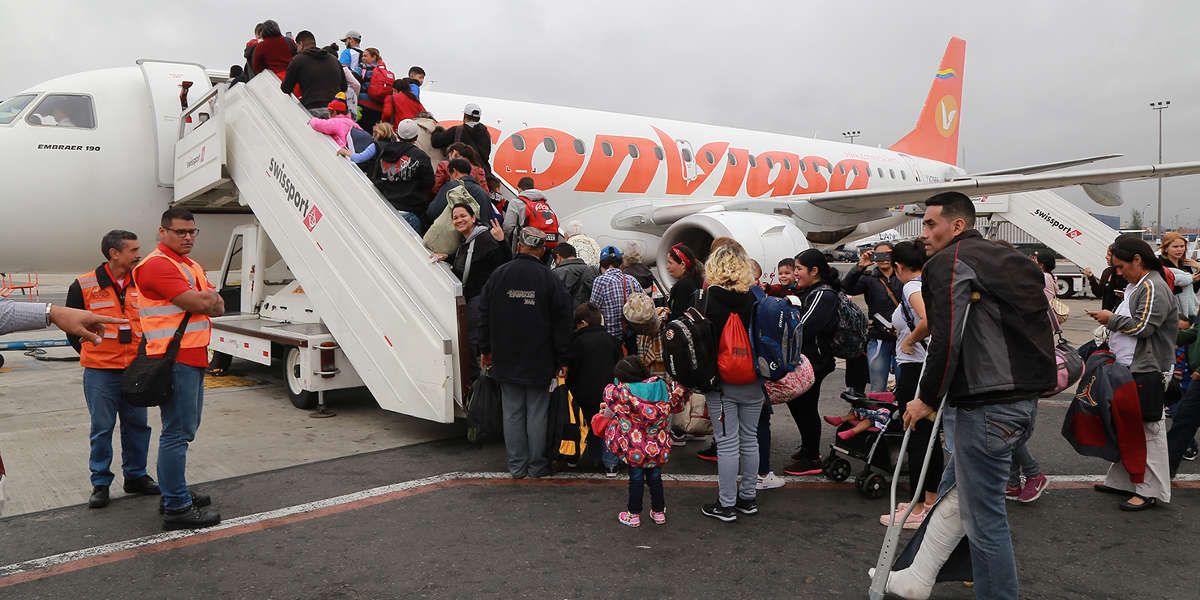
Plan Vuelta a la Patria
The Plan Vuelta a la Patria, created by President Nicolás Maduro, establishes an air and land bridge for the voluntary return of all Venezuelan migrants and their families who lack their own means to return, and incorporates all returnees into the programs of Venezuela, “the largest in the continent,” reports the government of Venezuela.
In the 2020 Report of Plan Vuelta a la Patria, the government of Venezuela listed three main reasons for the returns as shared by returnees: “64% of the repatriated compatriots identified economic problems and the impossibility of obtaining decent employment in the countries to which they migrated as the main reason for returning to the country; 54% specified constant harassment in the receiving country as an additional reason for returning, denouncing strong episodes of xenophobia, exploitation, labor and social mistreatment and 21% reported that they were suffering from severe health problems.”
In less than two months, more than 7,000 migrants from eight countries have returned to Venezuela. “A new beginning in the best place for the sons and daughters of Bolívar: Venezuela,” describes the government of Venezuela.
En este momento arriban al país 115 connacionales que se encontraban bloqueados en la frontera de Chile en otra jornada más del Plan Vuelta a la Patria. En un operativo 100% soportado por el Gobierno Bolivariano de Venezuela.
Bienvenidos a su patria ¡Patria de Bolívar! pic.twitter.com/Jo9I7XTtkw
— Yvan Gil (@yvangil) May 7, 2023
Plan Vuelta a la Patria
Information source: Cancilleria de Venezuela
What is the Plan Vuelta a la Patria?
It is a program created by President Nicolás Maduros Moros, which aims to offer support and encouragement to migrants who voluntarily express their desire to return to Venezuela.
The Bolivarian Government, in response to the situation of vulnerability or economic difficulty suffered by Venezuelan citizens residing abroad, makes a logistical, social, diplomatic and economic effort to offer a helping hand and an instrument of support to all for their return and reintegration into our society.
Phases of the Plan
The plan consists of three phases:
Phase 1: Enrollment in the plan
Phase 2: Logistics operation (transfer to Venezuela)
Phase 3: Insertion into the social protection system of the Bolivarian Republic of Venezuela.
? #EsNoticia | Gobierno Bolivariano retorna en vuelo especial de Vuelta a la Patria a 115 venezolanos bloqueados entre Chile y Perú (+Detalles) ?https://t.co/Do9XsyeCwt#VamosALaDefensaDeCitgo pic.twitter.com/kXDRvdfkqK
— Cancillería Venezuela ?? (@CancilleriaVE) May 8, 2023
What requirements does the plan require?
There is no prior condition or special requirement except to be Venezuelan.
Only required:
1.- Express the voluntary desire to return to Venezuela and do so with a positive and proactive attitude.
2.- Register in the Plan’s Registration System offering up-to-date and truthful information about the situation abroad and submit a copy or proof of the documents required in the registry.
In the event of not having documentation, the identity data required in the registry must be provided, including your residence address or the address and data of your relatives in Venezuela to carry out the corresponding verifications.
What happens if some data turns out to be false?
Any compatriot who submits false information to the registry and these are verified will be immediately excluded from the plan.
Similarly, people who try to create trouble or hinder the program with disrespectful attitudes or other negative behaviors will be excluded from the benefit.
What should be done once enrolled in the Plan?
Participate in the meetings and calls made by the diplomatic missions to inform about the Plan, be attentive to the calls, prepare adequately for the return and wait for the date for the transfer.
Does it have any cost for the migrant?
The Return to the Homeland program is essentially aimed at compatriots who are in a precarious economic situation, which prevents them from paying for their return by their own means and who can honestly certify said condition.
In this initial phase, the Venezuelan State will pay for the transfer to Venezuela. Other modalities different from air transportation are studied to reduce costs, as well as financing modalities depending on the capacity of each person.
Is the Plan permanent?
The plan is being applied in an experimental phase due to the number of requests received at the diplomatic missions of the Bolivarian Republic of Venezuela in which migrant compatriots state that they are experiencing situations of personal, economic and diverse nature difficulties, and request support for the return to the country
Can the Plan be accessed more than once?
The support for the return will be provided only once.
It is important to remember that the decision to migrate is voluntary and is made in exercise of the right to mobility that every human being has. In the same way, the Plan Vuelta a la Patria is a voluntary program. Once in Venezuela, if they decide to leave the country again, they are within their full rights and no one is going to stop them, but they should know that the support for the return will only be granted once.
How do I join the Social Protection System?
Upon arrival in the Homeland, everyone will be able -if they are not already- to join the social protection system of the Bolivarian Republic of Venezuela and the System of Social Missions.
They will be able to register in the Carnet de la Patria system and enjoy the benefits of our social policy under the same conditions as any compatriot. They will have neither more nor less rights. They will have the same opportunities. This system includes the possibility of applying for employment, housing, etc., according to the needs of each person or family group.
The Missions system will monitor the returned family group under a comprehensive concept to facilitate their effective and rapid labor and social reinsertion in our homeland.
Are there any political requirements to participate in the plan?
The Plan Vuelta a la Patria, like all the social policies of the Bolivarian Revolution, is inclusive and has no political or partisan bias. Only those people who have pending accounts with the courts, whether in Venezuela or abroad, who have participated in public acts of violence, or acts of hatred against the Venezuelan people, may their participation be conditioned.
Once enrolled in the plan, how long should I wait for the transfer?
The return will be as soon as the corresponding checks and verifications established in the registry are made and transportation permits are obtained, as well as the deadlines determined by the authorities of each country. In the same way, when the migratory permits and other requirements demanded in each country are resolved.
How will the order for the return be established?
The order in which the return lists will be defined will be decided according to the cases of greatest sensitivity and vulnerability in terms of health, families with children, pregnant women, the elderly, etc. They must be patient and wait for each stage of the repatriation to be fulfilled in a satisfactory and rewarding way for everyone.
What legal limitations will exist for the trip?
Only those established by the authorities of each country as well as the limitations in terms of capacity in the means of transport used.
Is the return to the homeland plan a right?
No. It is a social program to support and encourage the return of those who for various reasons have voluntarily left the country. The Venezuelan State is not obliged to do so, but it develops this social program in response to a real need, and compliance with the constitutional mandate that obliges us to provide protection to all citizens in vulnerable situations. It is a program to protect the human rights of migrant Venezuelans.
Venezuela returns 115 Venezuelans stranded between Chile and Peru
After several days in a highly vulnerable situation, 115 Venezuelans, who were blocked on the border between Chile and Peru, returned to Venezuela this Sunday, through a special flight of the Plan Vuelta a la Patria, through which the Venezuelan Government guarantees the protection and safe return of its compatriots.
Llegaron a Venezuela 115 compatriotas que se encontraban bloqueados en la frontera entre Chile y Perú. Resultado del Plan Vuelta a la Patria, gracias al esfuerzo de Pte. @NicolasMaduro están de regreso para reencontrarse con sus familias. pic.twitter.com/uZJzsTQrDb
— Yvan Gil (@yvangil) May 7, 2023
Through his account on the social network Twitter, the Minister for Foreign Relations, Yván Gil, highlighted the effort of the National Executive, headed by President Nicolás Maduro, so that the 115 Venezuelans could return home.
The welcome at the Simón Bolívar International Airport in La Guaira, which serves the city of Caracas, was in charge of the Vice Minister for Latin America of the People’s Power Ministry for Foreign Relations, Rander Peña.
Desinyer Ozuna, one of the returned Venezuelans, recounted the difficult situation he lived through until the staff of the Venezuelan Embassy in Chile approached him and informed him about the efforts of the Bolivarian Government to carry out this humanitarian flight.
“Very grateful to the Government of Venezuela, because I can return to my country to work and contribute what I can to the nation (…) I very much doubt that I will migrate again, there is no way to be at home, I prefer to stay fighting! can!” he said.
Likewise, Carlos García detailed the challenges he had to face as a migrant and his situation during the last days at the aforementioned border. “Without water, without food, you have to endure the low temperatures at night and the unbearable heat during the day, see boys and girls having work, the truth is that I do not wish that on anyone,” he said.
“…Thank you for the support and for taking us into account, the Venezuelan government did not abandon us and did what was necessary to return us to our homes,” said the returnee.
Meanwhile, Yelitza Urbina reported that the situation was “quite difficult and complicated,” highlighting the xenophobia of which they were victims.
Poemas de gran inspiración de Juan Antonio Pérez Bonalde: “Vuelta a la Patria”, para quienes retornan a su tierra con amor patrio, destaca el redescubrimiento de la identidad nacional. ¡Hermosa pieza lírica! ¡Se los recomiendo! ==> https://t.co/7GCGcQX0BJ pic.twitter.com/RAVxaDgTXk
— Nicolás Maduro (@NicolasMaduro) May 6, 2023
Plan Vuelta a la Patria
In August 2018, the Bolivarian Government led by President Nicolás Maduro created the Plan Vuelta a la Patria to guarantee the voluntary and safe return of Venezuelan migrants.
With this special flight, there are already 31,423 Venezuelans who have returned to Venezuela from 25 countries, in around 178 flights and 1 maritime transfer, through this humanitarian repatriation bridge, considered the longest-reaching in the world assumed by a government, as stated by the Ministerio de Relaciones Exteriores of Venezuela.
A Diplomatic Triumph
The president of Chile, Gabriel Boric, described as a “diplomatic triumph” the flight that, in the early hours of this Sunday, left for Venezuela in order to repatriate 115 Venezuelan migrants who were stranded between the borders of that country and Peru.
Chile’s Foreign Ministry reports that the plane with the Venezuelan citizens who were waiting to be repatriated and who were on the northern border of our country successfully took off from Arica to Caracas.
#EstamosAhí: Declaraciones del Presidente Gabriel Boric por salida de avión con migrantes en el marco del plan "Retorno a la Patria" del Gobierno de Venezuela. "Es un triunfo diplomático y un triunfo del diálogo de quienes buscamos soluciones. Felicito a las Cancillerías por… pic.twitter.com/tFgNFLWr4Y
— Mediabanco (@mediabanco) May 7, 2023
Through a statement, the Ministry of Foreign Affairs of the southern nation explained that the migrants boarded the Aerolíneas Estelar plane “in complete normality, previously complying with the requirements established by the Venezuelan Consulate in Chile, in coordination with the relevant national authorities, and in adherence to Chilean legislation and regulations, from the human rights perspective.”
“This first return flight of Venezuelans to their land of origin is a diplomatic triumph and a triumph of dialogue and of those of us who seek solutions,” Boric said from Punta Arenas after casting his vote in the constituent elections this Sunday.
 Dr. Soledad Quartucci | Founder
Latina Republic is a reporting, research, and advocacy nonprofit organization advancing human rights in the Americas. Latina Republic fills the void in coverage of urgent social, political, environmental, economic and gender inequities affecting the Americas. Latina Republic’s mission is to inspire humane policies that fortify relations between the U.S. and Latin America. Our work is guided by peaceful international relations focused on solidarity. We believe asylum and seeking refuge is a human right. Our work envisions a world where neighboring countries are seen as partners, and immigrants and refugees don’t have to live in the shadows. Our goal is to advance peaceful dialogue by highlighting local perspectives that don’t make it into the mainstream news. Our vision is that this knowledge will assist all stakeholders in solving regional problems while strengthening ties.