National Park Isla Gorgona to Become a World-Class Scientific Research and Nature Tourism Center
With an investment of 32 billion pesos, the Government of Change will strengthen the research and tourism potential of the Isla Gorgona National Natural Park, reports Presidencia de Colombia.
The installation of a radar, purchased and operated by the National Government, will aid in the fight against drug trafficking and illegal fishing.
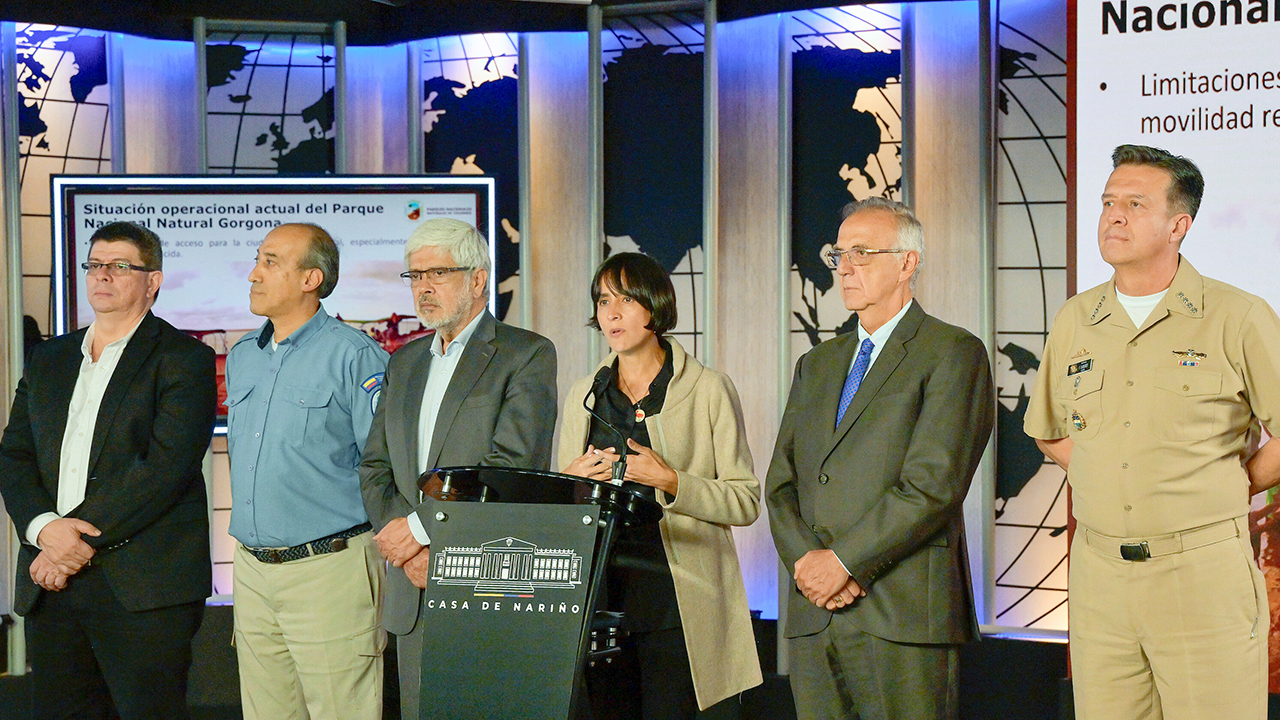
Bogotá D.C., February 12, 2024
An ambitious strategy, including actions and investments to promote scientific research processes, development of community-involved nature tourism, and improvements to enhance the conditions for visitors and residents of the Isla Gorgona National Natural Park, aims to make it a world-class tourist hub.
“We will strengthen the National Park with a research center that is already funded and with infrastructure worth 11 billion pesos for environmental education and tourism improvement,” announced the Minister of Environment and Sustainable Development, Susana Muhamad, at a press conference held this Monday at the Casa de Nariño.
The Minister noted that a scientific research program has been structured with the universities of Valle, Cauca, Nacional de Colombia, and Nariño, Invemar, and National Natural Parks, and a new diving station will be established to support these practices.
The Minister of Commerce, Industry, and Tourism, Germán Umaña Mendoza, emphasized that “the project in Gorgona is not only about ensuring security in this National Natural Park but also about strengthening the human capacities of the communities that depend on tourism on the Pacific Coast and, in this way, providing a conducive environment for international green investments.”
Regarding tourism, the investments made by this department, along with National Natural Parks, amount to 32 billion pesos and include the construction of a pier to facilitate visitor access, a tower for observing aquatic mammals, and the Yundigua and La Chonta trails.
Also, the monitoring and control center will be promoted, warehouses will be adapted, renewable energies will be implemented to ensure sustainable electricity supply, trail maintenance will be conducted, and changes will be made in accommodation roofs for ecotourism, among other works.
“Our Isla Gorgona National Natural Park has always been protected with the highest standards. On this occasion, we have proposed to develop the knowledge management strategy as the main route to generate more conservation, inclusion, and participation in the challenge of its care. We are excited about the possibility of hosting more researchers with better means,” said Luisz Olmedo Martínez, director of National Natural Parks.
ANLA Measures
The island’s adaptations will be made in compliance with environmental licensing protocols, protecting wildlife and using clean energy.
More than 3,500 square meters will be used for the installation of solar panels, asbestos roofs will be replaced, and panels will be installed in some cabins, as part of the energy transition process on the island.
Between July and December, the time for humpback whale watching, no pier construction works will be carried out.
The environmental license for the works was granted in 2015 in accordance with the current legal framework and was modified in 2022. In view of environmental monitoring and control, the ANLA imposed the following additional measures:
• Pier construction works cannot be carried out between July and December, the time for humpback whale watching.
• Pile installation works must primarily be carried out during low tide.
• Marine fauna observers must be present during the pier construction period.
• Monitoring and control must be carried out before, during, and after pier construction.
Likewise, strict environmental monitoring will be carried out for the project to comply with what is established in the license to protect the Park, stated Rodrigo Negrete Montes, director of ANLA.
National Sovereignty
The strategy for Isla Gorgona includes interventions to guarantee national sovereignty and security.
The Minister of Defense, Iván Velásquez, highlighted that this project will have a coast guard station, financed by this department, which will have 28 members of the National Navy.
The Government of Change has determined to guarantee the complete financing of the installation of the radar on the island, which will allow tracking of vessels used for drug trafficking and illegal international fishing, and will contribute to the scientific monitoring center, in one of the largest corridors in the Pacific and a strategic point for national security.
“We have agreed with the United States Embassy that the 12 million dollars of international cooperation will be allocated to improve accommodation conditions and facilities at the coast guard station,” he said.
“We have agreed that the financing of the radar will be done by the Colombian Government to strengthen capacities in the Pacific, preserve human life, counteract illegal fishing, and have control over possible transnational crimes,” emphasized the Minister of Defense.
The authority of the Isla Gorgona National Natural Park will be under the responsibility of the Director of National Natural Parks of Colombia, who signed with the Navy the management and operations protocols that can be carried out on the island.
See Also,
Ministry of Environment, Colombia.
 Soledad Quartucci | CEO/Founder, Latina Republic
Latina Republic is dedicated to promoting regional understanding through compelling narratives, articles, interviews, and reports that emanate from the heart of the Americas. Our foremost goal is to facilitate constructive dialogue by illuminating local viewpoints frequently overshadowed by mainstream media. Our mission is to equip all stakeholders with essential insights for addressing regional issues, thus empowering them in their efforts. We are committed to portraying the victories and hardships of everyday life in Latin America, while also chronicling the progression of social movements and amplifying the voices of those at the forefront of change.