


Latin American Investments in Education in 2022
On average, Latin American countries have allocated 16% of this year’s budget to education, according to a report by El Dinero, a Dominican press.
The Latin American region is investing, on average 3 percentage points more than the region’s GDP investment in this sector 25 years ago. The results of that investment are still to be determined, says the Joan Sebastian Vallejo, author of the report.
“An increase in quality, not years of study or cost, should be the target for improvements,” states Vallejo. The study evaluates a report by UNESCO that identified substantive advances in investment in Peru, Brazil and the Dominican Republic, but concluded that educational quality remains low.
The report points to the year before the pandemic “when over 40% on average of students in third grade and over 60% of students sixth grade were not reaching the minimum fundamental competencies in reading and math. Some countries lost ground,” states El Dinero.
In 2016 alone, the governments of Latin America and the Caribbean spent close to US$450 billion on public purchases, which includes the acquisition of goods and services and capital equipment, such as the purchase of computers for students and teachers in public schools, among others, explains Vallejo.
A study by the Inter-American Development Bank (IDB) states that since 2000, public spending per student in the region has grown in real terms. “It is almost 80% in the case of the primary level and almost 45% in the case of the secondary level and has exceeded US$2,000 per student per year at both levels,” publishes El Dinero.
UNESCO states that Latin America and the Caribbean face a crisis in education and achievements in fundamental learning remain a pending goal.
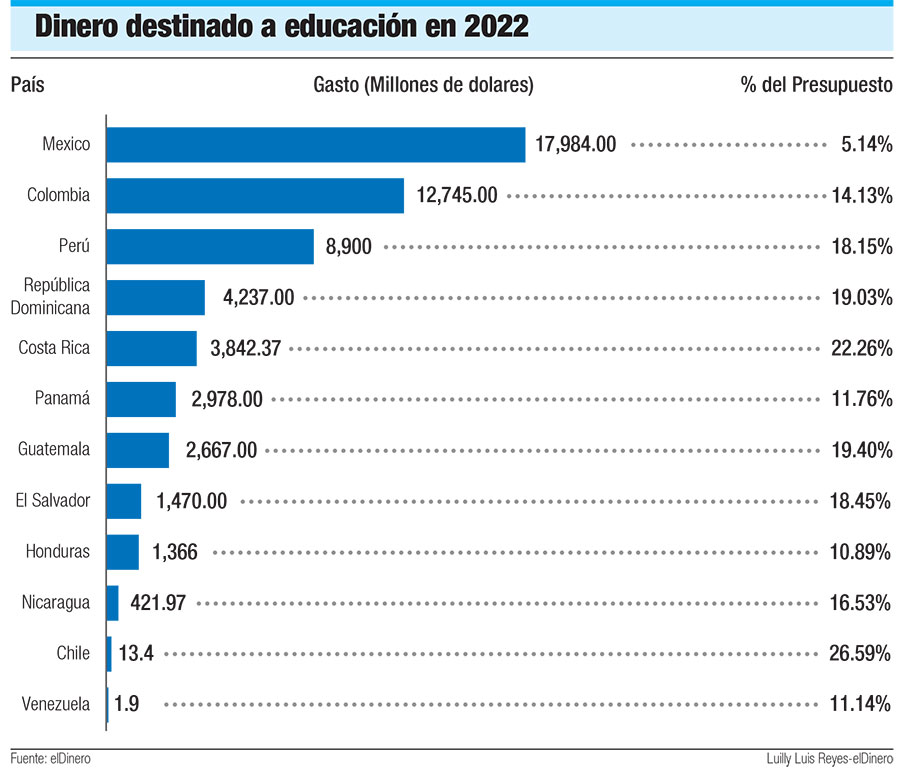
El Dinero carried out a survey to identify the budgets allocated to education (compared to other ministries) by country for 2022:
“It should be clarified that here we are talking about a budget that was allocated (2022) for this sector. This amount that each country allocates for their ministries is, in broad strokes, what the States dispose of to support elementary and secondary education this year.”
“As an example,” he continues, “the Dominican Republic allocates 4% of its GDP in Education, but the expenses for 2022 are equivalent to 19.03%. Same with Costa Rica. In regards to GDP for this year, this sector represents 6.4%, but in the budget, this ascends to an equivalent 22.3% of the total.”
At the regional level, “with some exceptions,” says Vallejo, “the Dominican Republic in 2022 has been one the countries with the greatest investment in education with a total ascending to US$4,237.00 millions. Above that by a wide margin are, Colombia (US$12,745.00 millions) and México (US$17,984.00 millions), although comparatively, the latter only destined 5% of its 2022 budget [to education].”
With a range that goes from 26% (Chile) to 5% (Mexico), on average, Latin America and the Caribbean will allocate 16% of the state budget for the year in the education sector, asserts Vallejo. A study by the Inter-American Development Bank emphasizes that keeping total GDP spending on productive items (education and investments) will boost long-term economic growth, cites El Dinero.
What can Latin America do to improve its education?
BBC Mundo identified 6 Steps.
1.Compensate for Inequality. Carlos Henríquez, coordinator of the LatinAmerican Laboratory Evaluation of the Quality of Education of UNESCO (LLECE), carried out a study in Latin America that identified extreme gaps in education: “The differences in scores between students within each country are more than double the gap between different countries.”
2. Train and and Value Teachers.
3- Train Parents to Help: Hold meeting days with parents in which they receive training and guidance on how to help their sons and daughters to improve their learning.
4- Lay the Foundations: The importance of preschool cannot be understated. Children who go to preschool obtain better results than those who do not have access to that initial education. “Preschool education is important for all children, but even more so for children whose homes do not have an environment that helps develop their skills,” states BBC Mundo.
5- Know what to invest in
6- Beat the race against time: Recovering children’s education after of the pandemic is urgent. Prioritize what to teach. When catching up, not all content lost can be covered; extend the hours of instruction, and make learning more efficient, for example, through small group tutoring.
 Soledad Quartucci | Latina Republic
Dr. Soledad Quartucci is the founder and CEO of Latina Republic, a 501(C)3 California-based nonprofit organization. Latina Republic is committed to improving the diversity and professional development of storytellers in the media industry as representation matters and affects the stories we tell. Latina Republic makes space for and empowers unheard voices and trains the next generation of leaders in the U.S.

