

The Ceremony of Candomblé and Overcoming the Legacy of Slavery in Brazil
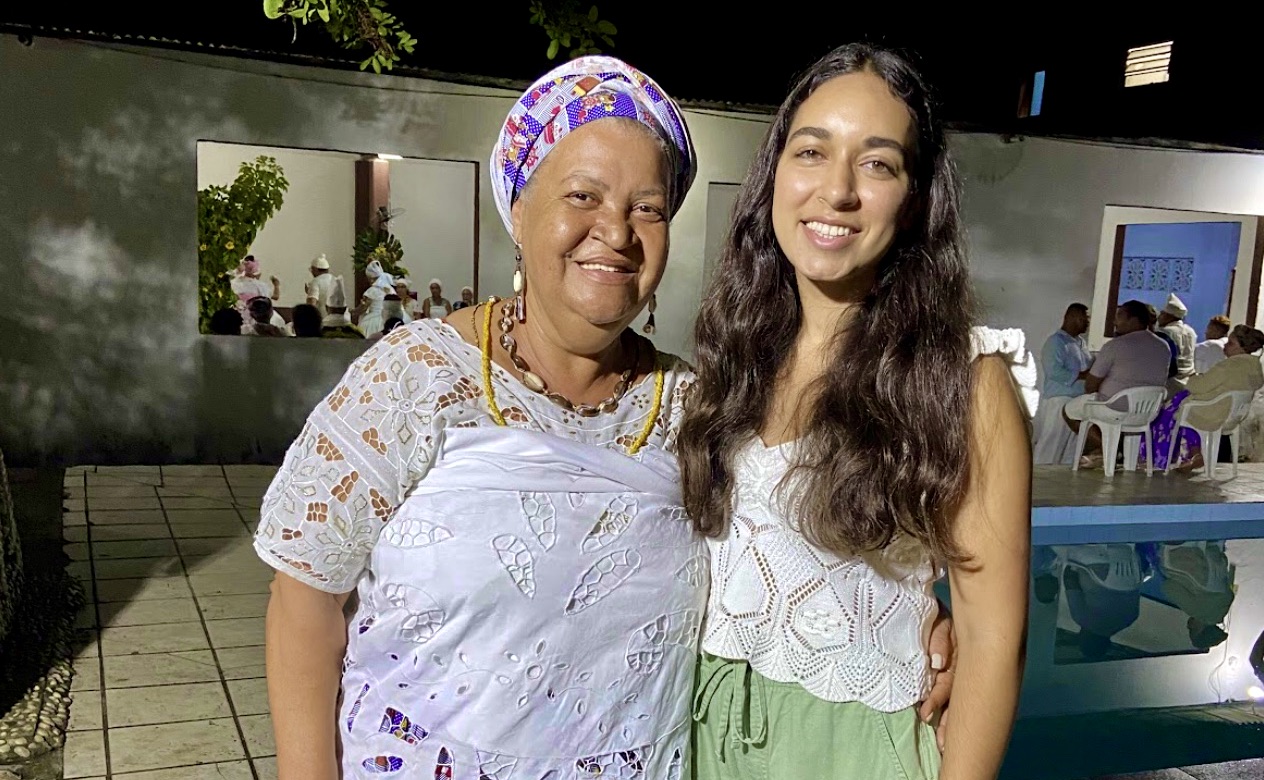
On the night of June 13th, while traveling through Brazil, I had the opportunity to attend a Candomblé ceremony in the city of São Cristóvão, Sergipe. As I entered the house, known as a “terreiro,” in which the ceremony was taking place, I was met with rhythmic chanting and drumming as men, women, and children clad in intricately woven gowns and vibrant head-dresses danced in the main room. In the center of the room stood a towering flower arrangement and the white-wash walls were decorated with enormous palm leaves.
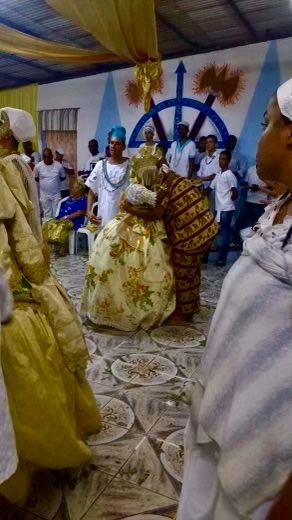
The ground was strewn with dry leaves and the pleasant scent of oranges filled the air. I was instantly made aware of the intimate nature of the space, as the dancers repeatedly took pause to greet and embrace one another (as well as those in the audience) with so much warmth and tenderness that there seemed to not be a single stranger in the room.
Furthermore, as part of the ceremony, participants would kneel, mid-dance, before one another’s feet and would proceed to kiss each other’s hands for several moments. There were times, as well, when I saw dancers suddenly become still as if in a trance. They would, then, either be silently led from the room or gently wrapped in a colorful patterned cloth before continuing to dance.

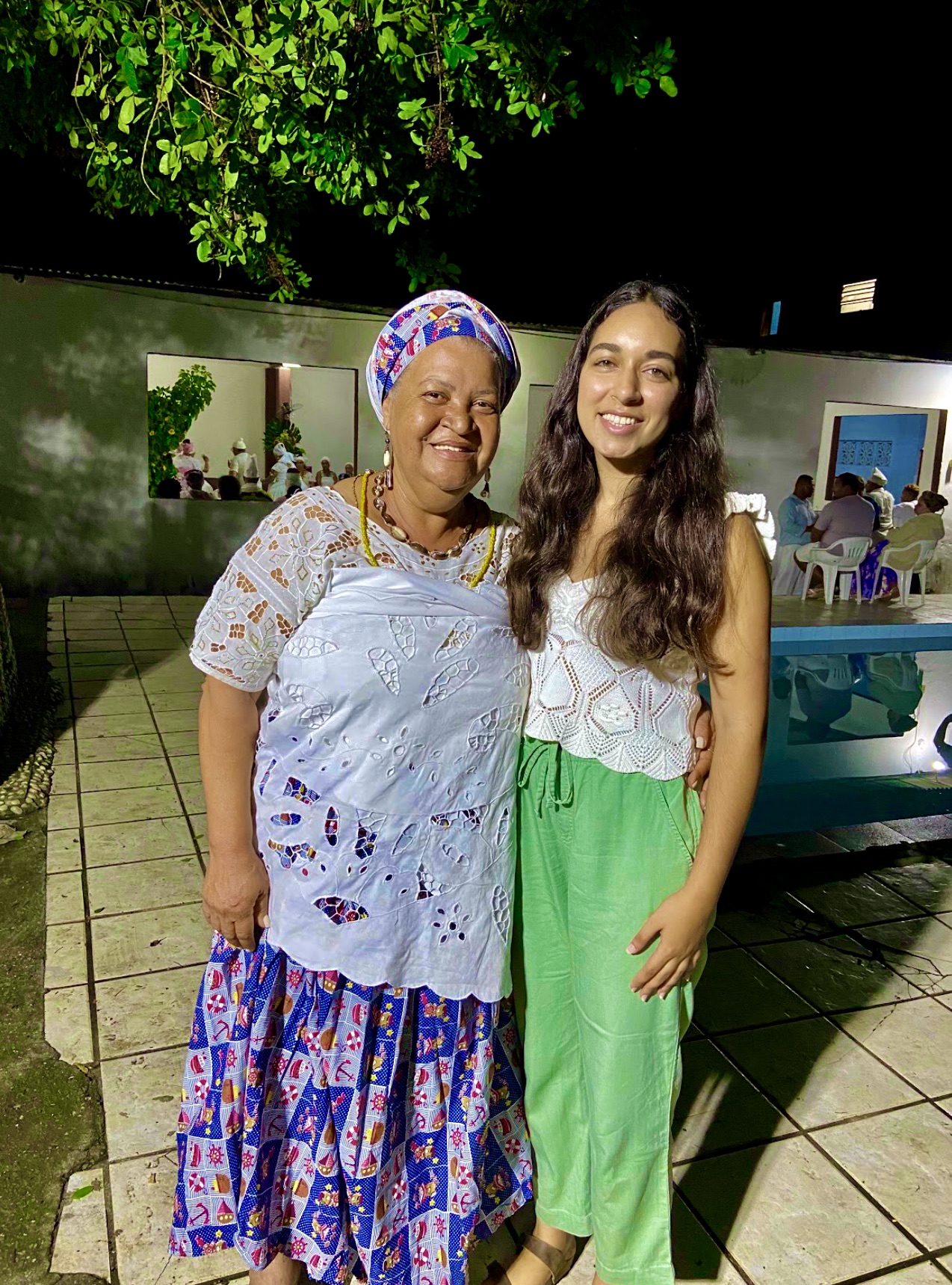
Following the ceremony, I had the chance to speak to Mãe Acácia, the owner of the house, who explained to me the purpose of the ceremony and gave a brief history of the practice of Candomblé in Brazil. From speaking to Mãe Acácia, I learned that the terreiro I was visiting, Axé Bamirê Oba-Fanidê, was founded in 1951 and has over 500 members. She told me that the dancers I had seen were honoring their spirit gods, or “Orixás,” which represent ancestors linking humans to the other world. She then graciously gave me a tour of the rooms that honored two different Orixás.

In the first room, she introduced me to the spirit of Exú, the most important Orixá in the Candomblé tradition and the guardian of towns, cities, and houses. In the center of the candle-lit room stood a totem representing Exú surrounded by various symbolic offerings.
In a second room, I saw the totem of Ogum, the Orixá being celebrated that night, which is considered to be the closest to human beings and is associated with war and fire, represented by the figure of a warrior. In both rooms, bowls of goat’s blood mixed with wine and honey as well as offerings of fruit and sacrificed animals were placed on the floor before the totems.

Before my visit came to an end, Mãe Acácia led me to the kitchen, where a pot of “feijoada,” or black bean stew, was being stirred and bowls of meat and vegetables were being prepared to be eaten by the participants and guests. The display further stressed the centrality of interconnectivity and mutualism to the practice of Candomblé.
Candomblé is an African diasporic religion that began in Brazil during the 19th century and developed as a way for descendants of enslaved African and Indigenous people to connect with the spirits of their ancestors. It first took the form of drumming that served as a means of communication between enslaved people being transported from Africa to Brazil, as they had been captured from different regions and intentionally separated and mixed in the ships so as to prevent communication and organized revolt.
Candomblé, ultimately, arose through the blending of traditional religions brought to Brazil by enslaved West Africans and the Roman Catholicism of the Portuguese colonists. As a result, many of the Orixás, while primarily inspired by traditional West African deities, are associated with Roman Catholic saints.
Every individual is believed to have an Orixá who serves to guide and protect their destiny. Therefore, the dancers I had seen enter a sort of trance had been possessed by their Orixás, a process that is thought to allow them to communicate directly with their deities.
As previously mentioned, Candomblé ceremonies generally take place in centers known as terreiros and are led by priests called “babalorixás” and priestesses called “ialorixás.” While terreiros are autonomous, they are distinguished by the traditional West African belief systems from which they derive their primary influence. According to the 2021 census, there are approximately 600,000 Candomblé practitioners and an estimated 2,250 terreiros in Brazil.
Furthermore, according to Mãe Acácia, in order to join a terreiro, one must undergo a 25 day initiation period marked by complete isolation from others and from the outside world. During that period, participants must sleep in a “esteira de palha,” or straw mat, and must walk barefoot and eat with their hands. It is believed that these conditions allow them to better feel and understand the experience of their enslaved ancestors.
The story of Candomblé is one fraught with religious and political tension. For much of its history, practitioners claimed to be Catholics in order to protect themselves from persecution. Following Brazil’s independence from Portugal and the religious freedoms enshrined in the constitution of 1891, Candomblé remained marginalized by the nation’s dominant Roman Catholic regime, which typically associated it with criminality.

Since the late twentieth century, however, a growing movement towards re-Africanization allowed for a departure from Roman Catholic influences and a call for closer ties to traditional West African religions. Similarly, in the twenty-first century, a renewed effort towards nurturing a collective Afro-Brazilian consciousness has led many to turn to Candomblé as a form of resistance against racial inequality. Ultimately, despite its early prohibition by the church and, in the sixties and seventies, by the military dictatorship in Brazil, Candomblé is now officially recognized and protected by the Brazilian government.
Brazil has the largest black population outside of Africa and the second largest in the world after Nigeria, with more than half the population identifying as black or mixed-race. Consequently, there is no Brazilian culture without African culture, with African traditions permeating every sphere of Brazilian life and national identity, from popular music like Samba, to dance styles like Capoeira, to widely used ingredients like okra and dende oil. Like many of these influences, the practice of Candomblé has allowed oppressed and marginalized communities in Brazil to maintain ties to their African heritage and to continue the struggle against unjust social conditions.
 Clara Rabbani | Board Member
My name is Clara Rabbani and I am a student at the University of Chicago, majoring in Anthropology with a minor in Environmental Studies. During my time with Latina Republic, I worked as an Environmental Writer with a focus on Brazil. My stories were primarily centered on activism, indigenous life, current environmental crises and innovations, and national NGOs. The conservation of nature and native biodiversity, as well as the preservation of indigenous voices have been major themes in my work. Working as a Latin American Correspondent has been an incredibly rewarding experience. Bringing attention to such urgent environmental topics has really informed my own understanding of our current social systems and governments and influenced the path I want to follow professionally. As I pursue my studies in the fields of Anthropology and Environmental Studies, I hope to continue building on the many skills I have developed in my time with Latina Republic. I truly appreciate the work the organization is doing as a platform for students to explore a variety of relevant themes while developing their own writing and voice.

