


“I sleep with the camera next to my bed,” Melvin Quaresma.
Brazilian photographer Melvin Quaresma was born in Belém do Pará, a city nestled in the vibrant north of Brazil. Though he grew up in the south—first in Florianópolis and now living in Curitiba—his northern roots continue to shape his artistic vision. “The first part of my childhood took place in Pará,” he explains, “and I believe that shaped my passion for photography and the way colors evoke nostalgia and intense feelings in me.”

The outskirts of Belém live in Melvin’s memories and are always present in his dreams and imagination. In fact, nostalgia is central to Melvin’s photographic practice.
“Growing up in Florianópolis, a relatively calm city so many years ago, led me to walk the downtown streets from a very young age and see the city with curious eyes – I think that’s where my passion for street and everyday photography was born, even without a camera in hand.”
Melvin has always enjoyed observing people and life; “I believe this tendency to photograph comes from childhood. I was very shy and observed everything with great attention, always liked that role of silent observer.”
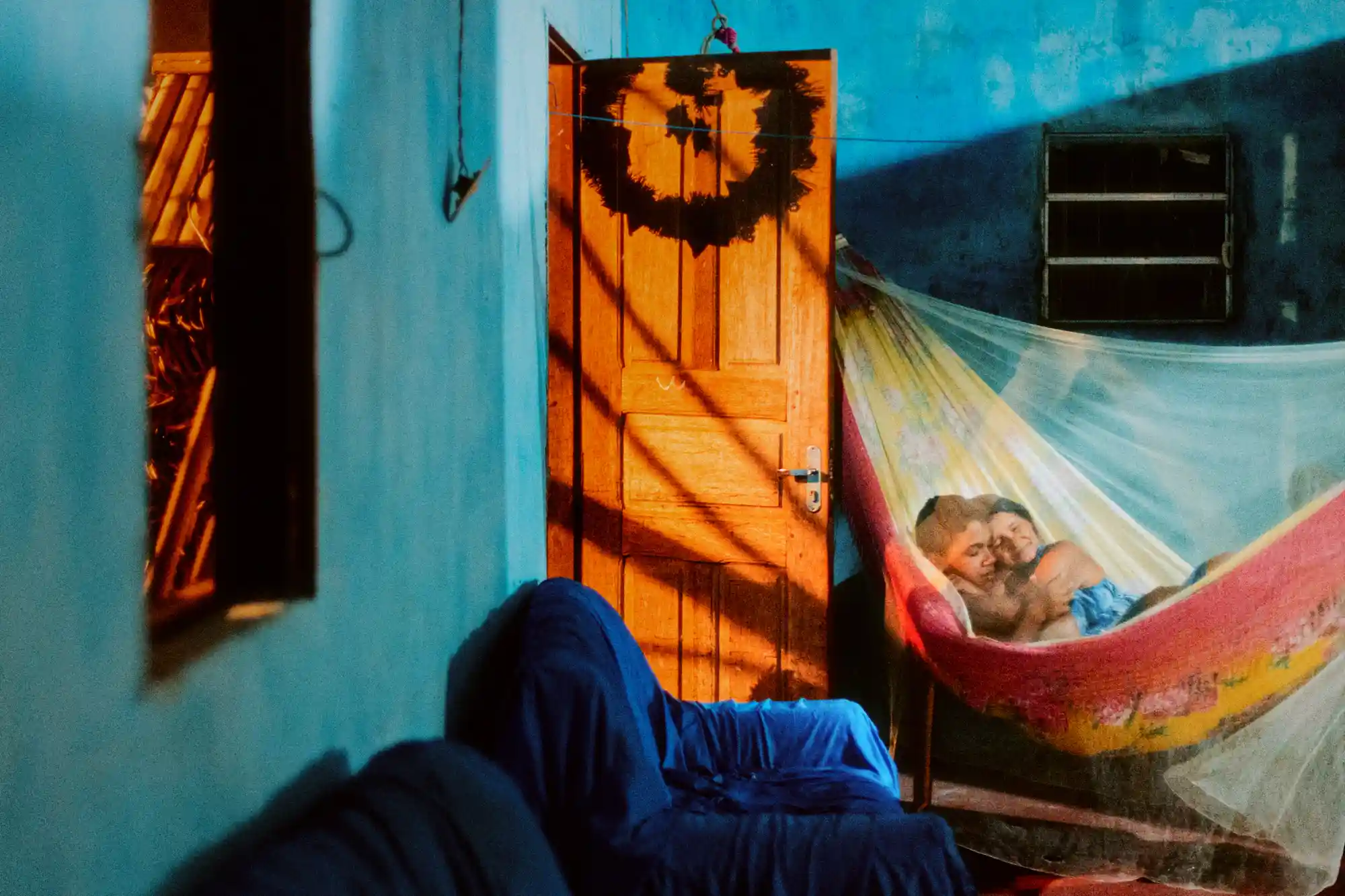
Reflecting on his childhood he recalls his grandmother’s home in Belém as a mix of textures and colors, a place soaked in memory.
“The house of my grandmother is a beautiful mix of colors on the walls, in the clothes, and the whole atmosphere of that space continues to permeate my photography,” he says.

That atmosphere became the foundation of his first photo series, 913. “This is a very meaningful series about my maternal grandmother’s house. From there came other small stories, snippets that are very important for my relationship with my maternal family. I feel that, along with my cousins, I was able to produce images that tell our stories, sometimes with harshness and painful feelings, and other times with lightness and humor – that mix that is life.”
Melvin’s journey into photography began at age 13, sparked by a family hand-me-down. “My father received a camera as a gift from his friends—because the one he had was so bad it became a joke among them,” he says. “He liked the camera— a Lumix FZ8 with manual controls—but ended up setting it aside, and that’s when I took the opportunity to start learning photography.”

Though his family didn’t work in the arts, they supported his creative pursuits. “My parents always loved photography and documented our life intensely with analog cameras,” he says. “Even with professions far from the artistic world, they always encouraged me to follow my dreams, and that made a big difference.”
Melvin’s early technical foundation came from a photography course, but much of his growth was self-driven. “Most of what I learned came from reading magazines, websites, and online research. Since the beginning, I’ve been very dedicated to reading about photography, watching content, and seeking information. It’s an addiction.”
For Melvin, photography is a way of perceiving life.
“I sleep with the camera next to my bed just for the pleasure of being able to photograph anything at any moment. I believe photography shapes how we see the world, how we perceive everyday situations – and it’s also a powerful tool for storytelling, whether those stories are harsh or light, denunciatory or simply appreciative. I don’t define my photography with a specific style, but there are themes that will always move me: people, their stories, the relationship between beings in general.”

Melvin carries a small camera and extra batteries everywhere.
“I have a sort of obsession with batteries and chargers,” he admits. “If I forget them for some reason, my creativity is affected. It’s a mix of superstition and the fear of being unable to photograph.” For planned shoots, he uses a checklist app to prepare gear and ideas.
His work often reflects social, cultural, and personal themes, though his intent shifts with the subject. “I think talking about the pursuit in photography, about what I want to capture and convey, is very difficult. Because when I photograph my daily life, my desire is to record memories, affections.”

“When I photograph cultural themes, my intention is to honor that tradition. When I photograph on the street, sometimes I just want to play with visual elements. Photography has many paths, and I like to explore many of them.”
One of his most poignant memories as a photographer is linked to a quiet, emotional moment between his grandmother and her late childhood friend. “There’s a photo of my grandmother passing a cup of coffee to her friend Riba, now deceased,” he says.
“It was the first time I saw her cry over a photograph I made, and I know it became her favorite. It motivates me so much to look at that image and know how much it means to her.”

Melvin says, “saudade,” a deep feeling of nostalgia, is embedded in much of what he does; “that feeling guides many of my projects. The messages, the concepts, vary.”
Among his long-term projects, Circenses stands out—a series now 13 years in the making. It began during his university years when he passed a circus and felt compelled to enter.
Years later, a serendipitous encounter with Circo Zanchettini rekindled that spark. “I opened myself once more to life and its chances, and since then I’ve frequently spent time with the Zanchettini family. Inside that space, I’ve made lifelong friendships.”

One of his dearest anecdotes comes from that same circus family. “My best friend from the circus, André, hardly ever appears in my photos, and he always complains,” Melvin shares.
“When I published a small book about the Zanchettinis, I made sure to include a big photo of him at the very end. I knew he’d read the whole book and complain there was no picture of him—until he got to the last page.”

Melvin’s love for Brazil runs deep. “A large part of my photography deals with Brazilian themes, our rich and passionate culture. I think our lived experience always influences the way we see people and the world, and I’m privileged to carry that Latin American warmth, that way of seeing others.”
A challenge he mentions is the difficulty of accessing certain equipment, technologies, and the high prices compared to our average wages.
“I could also mention issues related to safety,” he says, “but honestly I think that might further stigmatize our continent to readers from other parts of the world.
Melvin’s images often celebrate the richness of its traditions. In 2024, he had the chance to photograph the Marujada de Quatipuru, a religious festival in devotion to Saint Benedict.
“Even though I’m an atheist, with no personal connection to religion, I deeply admire manifestations of faith,” he says. “The figure of Saint Benedict is very present in my family; my great-grandmother’s name was Benedita.”
Looking ahead, his plans remain intentionally simple: “To live life with a camera by my side.”
He offers this advice to aspiring photographers:
“Be free, don’t cling to anything. Explore paths, processes, try to leave prejudices behind. And respect people; photography is not more important than human dignity.”

As for a dream project? He is already living it.
“Everyday street photography is an eternal project. Photographing my family is also something that will always stay with me. In June, I want to photograph a story related to the Festas Juninas in Pará.”
As he puts it, “My only dream project is to keep photographing life with all my love.”
To Learn More Visit:
 Soledad Quartucci, CEO, Latina Republic
Latina Republic envisions a world where the beauty and resilience of Latin American and Caribbean cultures are recognized and appreciated globally. By amplifying the voices of artists and cultural custodians, we strive to cultivate a deeper understanding of the region’s challenges and triumphs. Our goal is to inspire greater appreciation for the arts as a tool for empathy, unity, and transformative social change. Through our work, we aim to equip all stakeholders with essential insights for addressing regional challenges, ultimately enriching the global cultural landscape and portraying the victories and hardships of everyday life in Latin America.

