


DACA Final Rule-The Biden administration shores up DACA protections through a final rule. While strengthening the program, court challenges remain possible. Congress must do more.
After review of over 16,000 public comments, the Department of Homeland Security (DHS) published a final rule for DACA in the Federal Register. Through a series of amendments, the ruling strengthens the Deferred Action for Childhood Arrivals (DACA) policy, maintains the existing DACA eligibility guidelines and preserves the policies that have been in place since the program’s beginning. DACA’s final rule will be effective Oct. 31, 2022. DACA recipients will be considered “lawfully present” in the United States.
“Living from court decision to court decision has kept not only ME but EVERYONE under terrible anxiety for years,” states a Twitter user in response to @UnitedWeDream’s Twitter thread highlighting DACA’s current state of limbo among the courts.
Last July, the State of Texas challenged DACA’s legal standing, specifically, if the Obama administration had the legal authority to establish DACA as an exercise of executive discretion and whether the Obama administration followed appropriate procedures when creating DACA. Arguments against the program call to question the costs and resources used to accommodate those under DACA.
To strengthen DACA, the Biden Administration led the issuance of a DACA Final Rule. Despite some amendments to DACA, the program remains in legal peril at the Fifth Circuit Court of Appeals.
Opposing Views
Opponents of the proposed DACA rule argue that “undocumented noncitizens harm U.S. citizens and must be stopped.” They claim that DACA should be abolished, and believe that “requestors” do not have a valid claim for amnesty and are “illegal immigrants.”
Pending Court Decision
The three-judge panel did not issue a ruling the day of the hearing. There is no time limit on when the court must issue a decision. It may take weeks or months before a decision is announced.
Living from court decision to court decision has kept not only ME but EVERYONE under terrible anxiety for yearsss!!! #DACA https://t.co/bHU0ghquS7
— Yami ? (@yvmmss) September 2, 2022
DACA Final Rule
The final rule codifies the Deferred Action for Childhood Arrivals (DACA) program for undocumented immigrants brought to the U.S. as children. The intention of the final rule is to strengthen the program against legal challenges.
The regulation, announced on August 24th, is to take effect on October 31st and will temporarily allow over 611,000 immigrants to live and work in the U.S. legally without fear of deportation.
DACA has been governed by an executive memo since its release in 2012.
DACA Application/Work Authorization
One of the steps that was under consideration to lessen application costs for DACA applicants was to separate the application for the program, from the work permit application.
The 2012 DACA program required that the DACA application be filed at the same time as the work authorization application; however, immigration advocates worried that separating the applications could present risks to work permit renewals, possibly leading to backlogs. Ultimately, the change did not make the final rule.
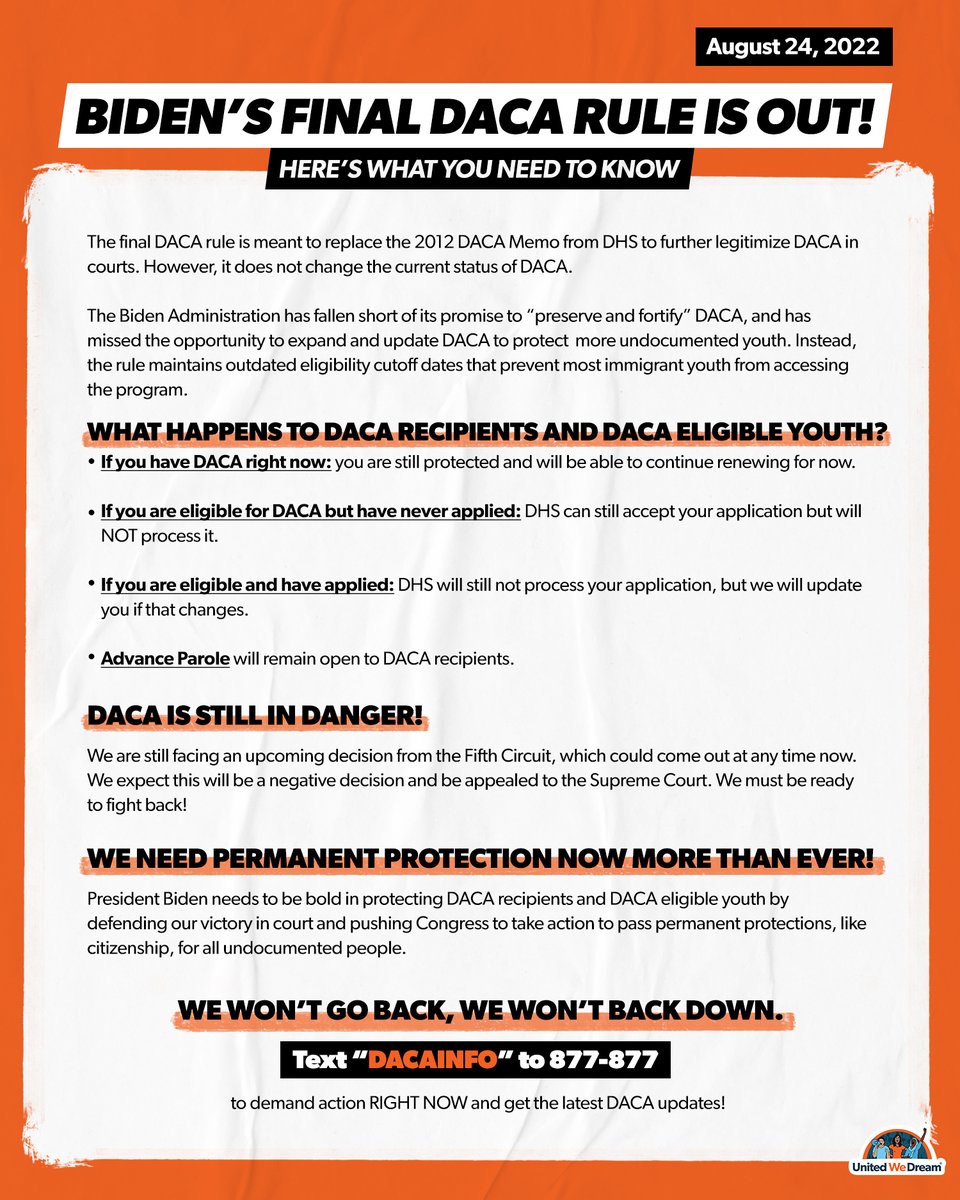
An Infographic breaking down the regulations under the final DACA rule, courtesy of United We Dream.
A Change in Automatic Disqualification
A major feature in the final rule is that a conviction of a crime will not automatically make someone ineligible for DACA, as detailed in the Department of Homeland Security’s document:
“Expunged convictions, juvenile delinquency adjudications, and immigration-related offenses characterized as felonies or misdemeanors under State laws are not considered automatically disqualifying convictions for purposes of this provision.”
Legal Peril
DHS maintains in the final rule that USCIS may terminate DACA at any time in its discretion. However, in the event that that occurs, DHS is requesting a NOIT prior to termination of DACA, but this would not apply if an individual is convicted of a national security related offense.
In response to the final rule, many recipients continue to express their disdain for the lack of protection in the form of permanent protections. The new rule has few amendments and maintains the DACA program as it was created in 2012, but the program is still vulnerable to legal challenges.
Twitter user @ziripena is one of many individuals who view the move as just another update without actual progress. In order to ensure protection for DACA recipients, advocacy groups and activists call for the protection of recipients through permanent residency, echoing a need for permanent protection.
 Kimberly Gabriela Martinez | Immigration Writer
Kimberly is an undergraduate student majoring in Political Science at UCI. She grew up in a predominantly Latinx community in Southeast LA and is the daughter of two Honduran immigrants. Having seen the obstacles that many immigrants face first-hand has inspired her to pursue a career that allows her to work directly with underserved communities. Making sure that underrepresented stories and voices are heard is important in removing the negative stigma around the immigrant community and she hopes to contribute to this change.