
Francia Márquez Advocates for Care as Fundamental Right
Vice President and Minister of Equality and Equity, Francia Márquez Mina, urged the Inter-American Court of Human Rights to consider declaring care as a fundamental right and to encourage its member states to ensure its implementation.
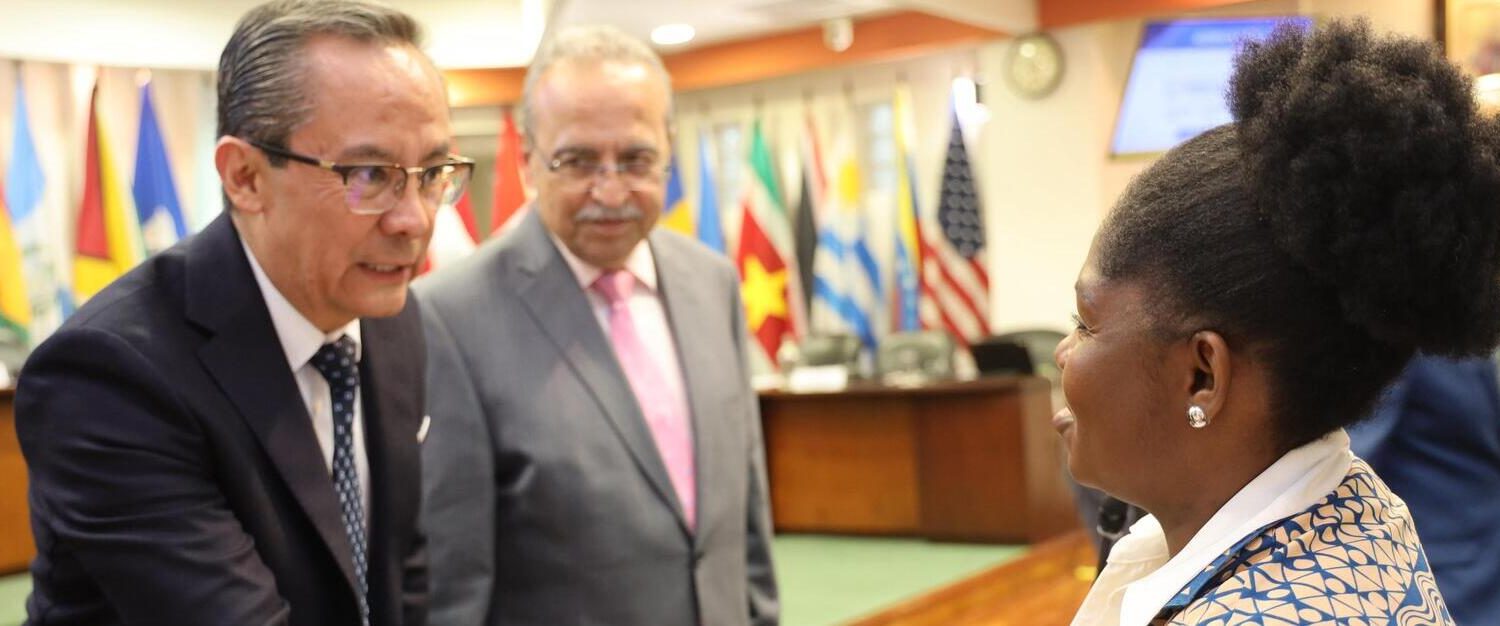
As the spokesperson for Colombia at the Public Hearing on Consultative Opinion regarding the right to care and its interrelation with other rights, held on March 12 in San José, Costa Rica, the Vice President invited the countries that are part of the Inter-American Human Rights System to regulate the working conditions of caregivers and to provide guarantees to those who require care. She also emphasized the need to expand the scope of the right to care, moving from an individual to a collective and community vision.
“We must create a society of care that transforms the existing society of fear, insecurity, and militarization,” she said.
Vice President and Minister of Equality and Equity, Francia Márquez Mina, requested the Inter-American Court of Human Rights (IACHR) to consider care as a fundamental right and urged member states to ensure its implementation. She also called for regulating the working conditions of those who perform these types of jobs, aiming for their formalization and decency, as well as providing guarantees to those who require care.
Speaking in San José, Costa Rica, at the Public Hearing on Consultative Opinion regarding the right to care and its interrelation with other rights, the high-ranking official insisted on the need to expand the scope of the right to care, moving from an individual to a collective and community vision.
“Life is being depleted every day on the planet. Climate change highlights the danger of the extinction of human life, which, unlike nature, will not be able to regenerate unless we adopt a comprehensive planetary care policy. The real foundation of life is the interdependence among all that exists: ‘Ubuntu, I am because we are,’ and not in the division that the neoliberal model has created. They are societies of neglect, based on separation, anthropocentrism. This is reflected today in social crisis and the precariousness of care work,” she said.
In this sense, she stressed the urgency of creating a society of care that transforms the existing society of fear, insecurity, and militarization:
“This implies that care be an ethical-political principle that promotes a new social and economic paradigm; a new society centered on care for the sustainability of life,” she emphasized.
For Márquez Mina, Latin America and the Caribbean are regions that provide life to the world, and it is necessary to articulate efforts that enhance the region’s own forms of care.
“The recognition of the right to care as a fundamental right implies its guarantee by the State, under conditions of equality and equity. In this way, Colombia wants to move towards a caring society as an alternative to an unequal and inequitable society. Being a diverse nation settled in one of the most biodiverse territories on the planet, the Colombian state must favor and equally include the different caregiving relationships among people and with their territories,” she said.
The high-ranking official highlighted precisely that Colombia is a country with 52 million people, in which nearly 16 million require care or support daily: nine million children and adolescents, three million people with disabilities, and four million older adults, among others.
However, the state coverage of these care needs remains highly insufficient, as 68% of children under five only have care options at home, and 92% of people with disabilities are supported by family members or live alone. Similarly, there are seven million people fulfilling care needs without remuneration, of which 86% are women.
In her presentation to the IACHR – acknowledging that many sectors and unions in the country have mobilized to have care recognized as work and to guarantee decent working conditions for those who perform it – the Vice President and Minister of Equality highlighted the efforts made by President Gustavo Petro’s government and the jurisprudential path that the country has taken in recognizing care as a fundamental right.
She highlighted, for example, the creation of the National Care System and the Care Directorate within the Ministry of Equality and Equity, as well as the rulings of the Constitutional Court that have recognized the fundamental right to be cared for and the right of caregivers to do so without discrimination.
She also recalled how that same Constitutional Court has considered ecosystemic elements as subjects of law and of special constitutional protection, due to their link to the life and cultural integrity of the communities of ethnic peoples, such as the ruling in favor of the Atrato River and its tributaries as subjects of special protection, while highlighting that, from the perspective of indigenous peoples, Afro-descendants, and Rrom, and collective territories, the right to care is connected to the rights to life, cultural integrity, and ethnic-territorial rights.
“In Colombia, we are understanding care as a pillar of the individual and collective well-being of our society, as a social function, of general interest, and of public utility (…) we are advancing towards material equality, ensuring that no population or way of life is marginalized or excluded from our conception of the State,” she noted.
The participation of Vice President and Minister of Equality and Equity, Francia Márquez Mina, in this Public Hearing, follows a request for a consultative opinion presented to the Inter-American Court of Human Rights by Argentina, in January 2023, on “the content and scope of the right to care and its interrelation with other rights.”
The court then invited member states to present their oral arguments and defined convening a face-to-face meeting, which took place on Tuesday at its headquarters in San José, Costa Rica, during the 165th session.
 Soledad Quartucci | CEO/Founder, Latina Republic
Latina Republic is dedicated to promoting regional understanding through compelling narratives, articles, interviews, and reports that emanate from the heart of the Americas. Our foremost goal is to facilitate constructive dialogue by illuminating local viewpoints frequently overshadowed by mainstream media. Our mission is to equip all stakeholders with essential insights for addressing regional issues, thus empowering them in their efforts. We are committed to portraying the victories and hardships of everyday life in Latin America, while also chronicling the progression of social movements and amplifying the voices of those at the forefront of change.