

“Although I am still searching for my own style, I confess that deep down I don’t want to find it completely; I prefer to remain in a state of constant exploration and transformation.”
For María Gloria Martínez Navor, photography is not just a way of seeing the world but a way of inhabiting it. Known on Instagram as @gloria_fotografia_mx, the Mexico City–based photographer traces her visual language back not only to the capital where she was born, but to the municipality of Nezahualcóyotl, where her identity was shaped.
She grew up among its colorful streets, surrounded by the sounds of popular festivities and family Sundays at Parque del Pueblo. In her memory, “on every street there was a chapel dedicated to the Virgin of Guadalupe,” and afternoons were marked by older neighbors pulling chairs outside their homes, devoted to simple contemplation. Nezahualcóyotl, she reflects, is “a municipality that, despite being born amid scarcity, grew through the effort of its people.”

That upbringing was marked by contrast. For years, Gloria commuted daily from the periphery into Mexico City to study—an experience that came with risk and physical, emotional, and economic exhaustion. Today, that reality lives on in her images. It shapes the way she captures “social resistance and its cultural expressions, the power of the collective, and the discovery of peace and beauty in the simplest, everyday acts.”
Her relationship with photography began early. As a child, she eagerly borrowed the family’s automatic camera whenever she could—on walks, during celebrations, or simply to photograph her pets. Some of those early images still survive, preserved in an album her mother dedicated to family memories. The camera itself remains with her too, a quiet relic she sometimes wonders might still work.
What drew her to photography, she says, is its ability to transcend barriers. Through images, “emotions can be conveyed, memory preserved, and stories or experiences told that would be difficult for me to express with words.” The camera became her means of seeing life “in a deeper, more empathetic, and freer way.”

Though her family was not artistic in a formal sense, she was raised by two women she deeply admires—her mother and her agüe, as she and her siblings affectionately called their grandmother. Their determination opened the door for her first encounters with art during adolescence, particularly music and photography.
Her formal introduction to the medium came in high school through an analog photography workshop. Although she couldn’t continue at the time, the experience planted something lasting. For years afterward, she recalls, she continued making “clicks” mentally, even without a camera. She fed that curiosity by attending exhibitions and following the work of established photographers whenever possible. In 2024, she formally resumed her training at the Community Film and Photography School Pohualizcalli, where she continues to learn.
Photography, for Gloria, is both inward and outward looking. Through the lens, she seeks “to connect emotionally and reconnect with myself,” capturing the everyday life around her while allowing herself to be surprised by what the street offers. The photographic image, she says, is “a language of honesty: a natural, beautiful, and powerful way to dialogue and flow with the world I inhabit.”

Her practice leans toward street photography, documentary work, and photojournalism. While she acknowledges she is still searching for a personal style, she admits she doesn’t want to find it completely. Remaining in a state of constant exploration and transformation matters more to her than settling into a fixed aesthetic.
She is deeply drawn to cultural and social expressions, which she sees as mirrors reflecting identity and resistance in an increasingly accelerated, globalized world. At the same time, she finds joy in uncovering beauty in what often goes unnoticed—ordinary scenes that, for reasons she can’t always explain, “find me and take on a special meaning.”

Working in public space in Mexico, she acknowledges, carries risk. Street photography, she says, unfolds within a broader context of insecurity. Even so, she is grateful each time she returns home with the satisfaction of having walked the streets simply to observe with intention and connect with people and their spaces. “There are countless stories unfolding every day that deserve to be fixed in time,” she reflects, describing her photographic path as “enormously rewarding.”
She doesn’t follow a strict ritual before shooting. Instead, she sets small challenges—seeking an unfamiliar angle or composition—to push herself out of her comfort zone. Beyond that, she prefers to drift, letting surprise and intuition guide her.

What she seeks to capture is complexity: “the beauty, the contrast of emotions, and the complexities of what is lived on the streets.” Her goal is to make visible what she finds meaningful, important, and transformative.
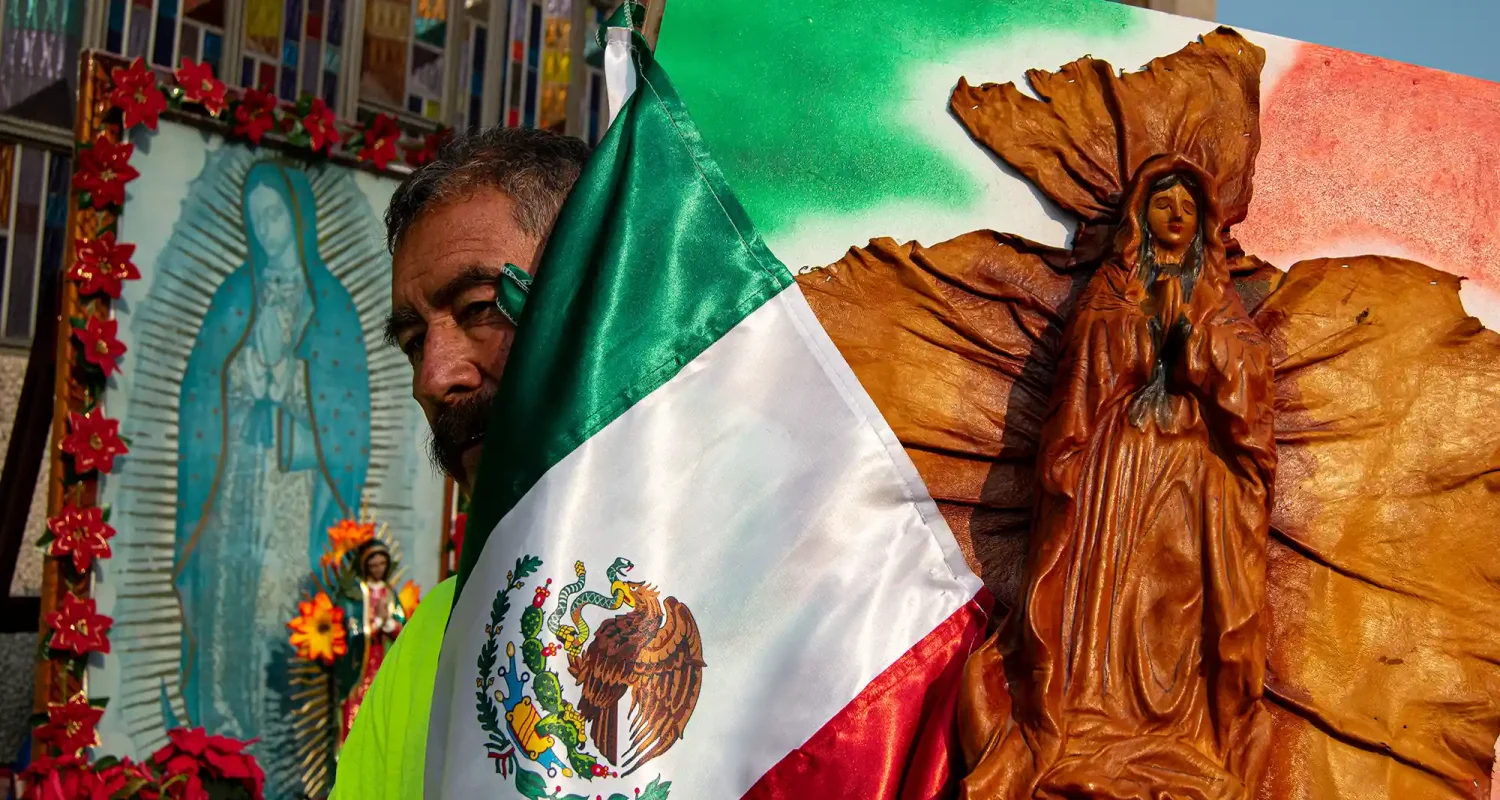
One of her most significant ongoing projects centers on the devotion to the Virgin of Guadalupe. Living near the Basilica, she began documenting this faith practice in 2024. Though she does not practice a religion herself, the beliefs of her agüe and her mother were passed on to her, and through their faith her interest emerged. She sees the cult of the Virgin of Guadalupe as “a blend of faith and memory,” where identity, resistance, and spiritual mestizaje converge. For two years now, she has been documenting how this devotion endures despite the relentless passage of time.

A single photograph, however, stands as a turning point in her life. Titled “Los niños héroes,” the image continues to resonate deeply with her. It is a raw portrayal of social inequality and injustice, and of the vulnerability in which thousands of people—especially children—live. “It makes me think that, as a society, we keep failing again and again,” she says. The brief time she spent with the children taught her about brotherhood, family, affection, and strength. Shortly after making the image, she stepped away from photography for many years, unable to return without that photograph resurfacing in her mind.

Much of her series work focuses on cultural and social expressions within her city, allowing her to connect past and present through traditions passed down across generations. When photographing them, she is mindful of her role as a witness, striving to be respectful and to convey the emotional essence of what is unfolding.
Among her most vivid memories are moments captured during Day of the Dead celebrations and carnivals, where costumes—catrinas, eerie figures, and imagined characters—allow people to step into other versions of themselves. She sees costume as an act of freedom, a release from routine, and photographing these moments makes her feel, at times, as if she inhabits another reality—one where she feels deeply at ease.

Looking ahead, Martínez Navor holds several projects in progress. She hopes to document as many cultural expressions of Mexico as possible and dreams of returning to Nezahualcóyotl with a camera, to reconnect with its streets and its people. She also aspires to teach photography one day, particularly in places with limited access to art, convinced that artistic practice at any age can transform lives. A dream project continues to take shape in her mind: uniting photography with music, her other great passion.

Her recent years reflect steady growth. In 2025, she continued her training at Pohualizcalli, participated in the collective exhibition Una mirada global a lo cotidiano at the Centro Queretano de la Imagen, and exhibited work in Vienna as part of Verano Vienés (The Latin American Photo & Film Fest). She collaborated on exhibitions in Mexico City, installed her first photo mural in Iztapalapa under the guidance of street photographer Fermín Guzmán, and received international recognition, including an honorable mention at the Paris International Street Photo Awards. Her work was also selected for upcoming exhibitions in Mexico in 2026.
If she could offer advice to her younger self—and to new generations of photographers—it would be simple: practice relentlessly and don’t doubt your talent. Consume art, live fully, and let experience shape your images. As she recalls from the words of Manuel Álvarez Bravo, “There is time, there is always time.”
To Learn More Visit:
 Soledad Quartucci, PhD, CEO, Latina Republic
Latina Republic’s cultural reporting highlights the artists, storytellers, and visionaries shaping the creative heartbeat of Latin America and its diaspora. Through in-depth interviews and narrative features, we celebrate the traditions, identities, and everyday histories that define our communities. Our work uplifts emerging and established voices, giving space to the cultural movements, personal journeys, and artistic expressions that inspire connection and deepen understanding across the Americas.

